
Rituximab
Also known as: MabThera · Rituxan · Truxima · Riximyo
Rituximab is an intravenous biologic that works by depleting a particular group of immune cells. It has become one of the mainstays of treatment in certain forms of vasculitis and remains valuable in rheumatoid arthritis. Because it changes part of your immune system for months, it needs careful planning.
Calm, careful medication review by a consultant rheumatologist.
Rituximab: a guide for patients
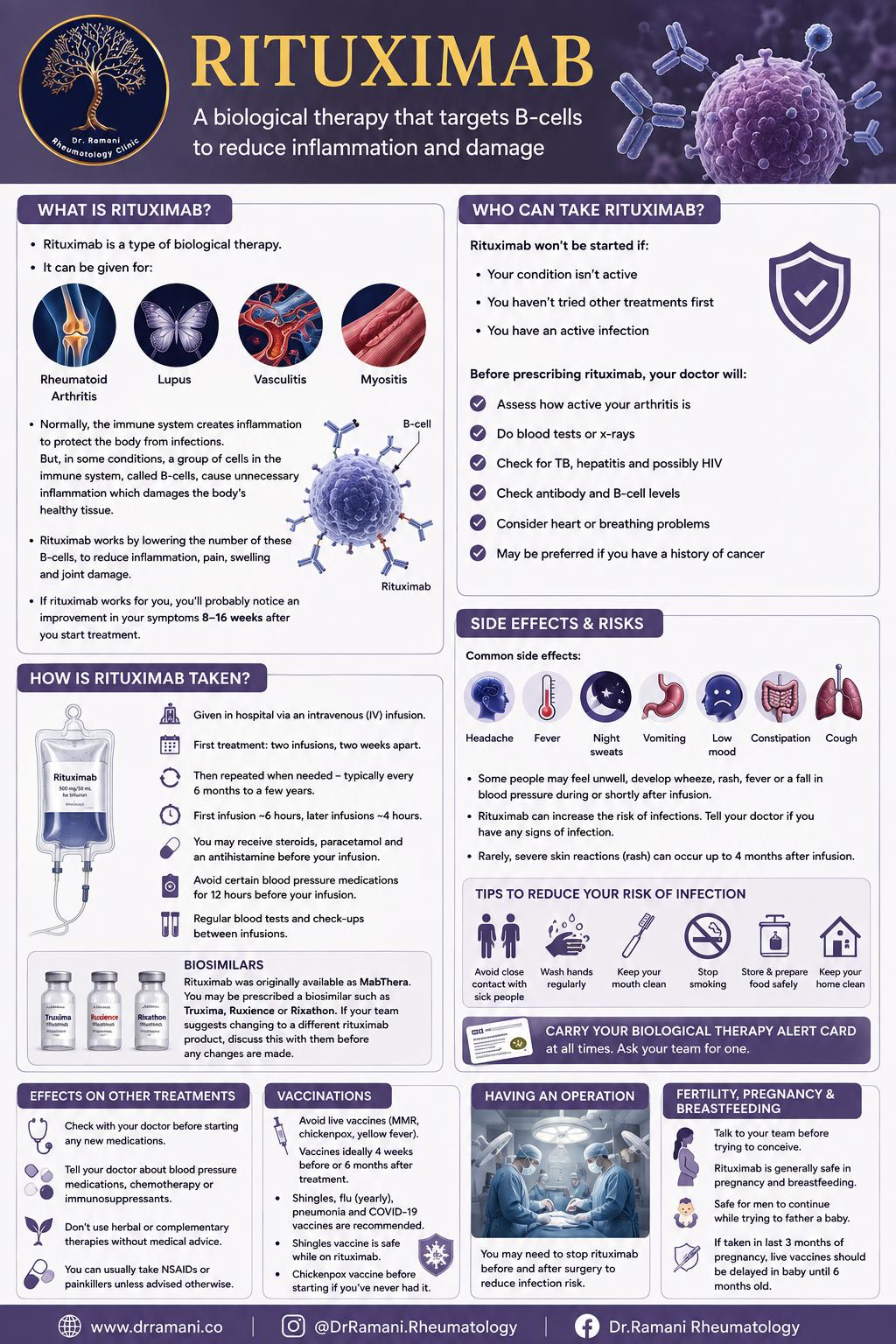
Tap the image to open the full-size version you can save or print.
For nurses and infusion staff
This is the two-page pack I use for rituximab infusions in day-care. Page one is the physician order and nursing checklist covering pre-infusion screening, dose and the infusion rate steps. Page two is the infusion monitoring chart for vitals and reaction checks. Nurses are welcome to print it for use in the infusion room.
What this medicine is
Rituximab is a monoclonal antibody directed against CD20, a marker on the surface of B lymphocytes. B cells make antibodies and help drive several autoimmune diseases, so removing them from the circulation can quieten the disease for a long period. It is given as a drip into a vein, in a hospital or day-care setting, usually as a course of infusions rather than a daily medicine, and the effect can last many months. Because it works by depleting cells rather than blocking a signal, the timing of repeat courses is guided by your symptoms, examination and blood tests. Your specialist decides the regimen, so I do not publish dose schedules here.
Uses and context
Rituximab may be used in rheumatoid arthritis after suitable prior treatment, typically when methotrexate and often a TNF inhibitor have not given adequate control, and in selected forms of ANCA-associated vasculitis including granulomatosis with polyangiitis and microscopic polyangiitis, both to bring disease under control and to maintain remission. It also has other specialist uses in autoimmune disease, for example in some cases of Sjogren's-related complications, inflammatory myositis, lupus manifestations and certain connective tissue disease-related lung involvement. Indications and local approvals vary, and this list is not exhaustive. It is also used in haematology, so the leaflet may describe uses that do not apply to you.
How this relates to rheumatology care
Realistic benefit and timing: in rheumatoid arthritis, improvement usually builds over about eight to sixteen weeks after a course, not within days. In vasculitis, response is judged with blood tests, organ function and clinical examination. A course typically holds benefit for six to twelve months or longer, and I plan repeat treatment based on how you are rather than a fixed calendar alone. Because B-cell depletion reduces your antibody responses, I pay attention to two practical things: infections, and vaccine timing. Vaccines work far better when given before an infusion or well after B cells have recovered, so I plan them deliberately. Related pages you may find useful are my guides to rheumatoid arthritis, vasculitis, granulomatosis with polyangiitis-type disease and Sjogren's syndrome.
What safety checks may matter
Hepatitis B screening before starting, including surface antigen and core antibody, because rituximab can reactivate a past hepatitis B infection; antiviral cover is arranged if needed
Hepatitis C and tuberculosis screening, and HIV testing where appropriate
Baseline full blood count, kidney and liver function, and immunoglobulin levels
Immunoglobulin levels and blood counts rechecked before repeat courses, since low immunoglobulins increase infection risk
Vaccination review and planning before treatment, since responses are reduced once B cells are depleted
Premedication before each infusion, commonly paracetamol, an antihistamine and a corticosteroid, to reduce infusion reactions
Observation during and after each infusion, with the drip rate adjusted if a reaction occurs
Review of any current infection, and postponement of the infusion if you are unwell
Side effects and red flags
If you have emergency symptoms such as severe allergic reaction, breathing difficulty, chest pain, stroke-like symptoms, severe abdominal pain, vomiting blood, black stools, sudden vision loss, severe infection symptoms, or severe weakness or confusion, please seek urgent medical care first rather than waiting for a WhatsApp reply.
Fever, chills, a persistent cough, night sweats or any sign of serious infection
During or shortly after an infusion: breathlessness, wheeze, chest tightness, throat swelling, flushing with dizziness or a fall in blood pressure
Yellowing of the eyes or skin, dark urine or right-sided abdominal pain, which can suggest liver or hepatitis problems
A painful blistering rash in a band, which may be shingles
New weakness, clumsiness, changes in vision, speech, personality or thinking that develop over days to weeks
Recurrent or unusually severe infections, or infections that keep coming back after treatment
Facial or tongue swelling, or another sign of a severe allergic reaction
Things worth knowing day to day
Infusion reactions are most likely with the first infusion. They are usually managed by slowing or pausing the drip and giving extra medicine, and this is exactly why premedication and observation are used.
Infection precautions: contact me promptly if you develop fever or feel significantly unwell, and postpone an infusion if you have an active infection.
Avoid live vaccines. Non-live vaccines such as influenza, COVID-19, pneumococcal and shingles-inactivated vaccines are encouraged, but timing matters: ideally before a course, or several months after, so I plan them with you.
Tell any surgeon or dentist that you are on rituximab. Procedures are usually planned away from an infusion, and any infection is treated first.
Low immunoglobulin levels can develop with repeated courses and may lead to more frequent infections. That is why I check them and sometimes space courses out or change plan.
Progressive multifocal leukoencephalopathy, a serious brain infection, has been reported very rarely with rituximab. It is genuinely rare, but because it matters I ask you to report new neurological symptoms such as weakness, changes in vision, speech or thinking rather than waiting.
Pregnancy needs planning. Rituximab is generally avoided in pregnancy and effective contraception is advised during treatment and for a period afterwards, as advised by your specialist. If you are hoping to conceive, tell me early so we can plan the sequence of treatment.
Breastfeeding should be discussed individually before you restart or continue treatment.
Questions patients often ask me about this medicine
Speak with me
If rituximab has been suggested for you, or you are due for a repeat course and want your monitoring and vaccine timing reviewed, please message my clinic. I will plan it carefully around your life and your disease.
Other medications used in rheumatology care
This page is for general education only and does not replace medical advice. Please consult a qualified healthcare professional for diagnosis and treatment. Do not start, stop, or change any medicine without advice from your doctor.