
Piriformis Syndrome
When the piriformis muscle deep in the buttock becomes tight or irritated, it can press on or irritate the sciatic nerve. This may cause deep buttock pain, tingling, or pain running down the leg, often worse after sitting for long periods.
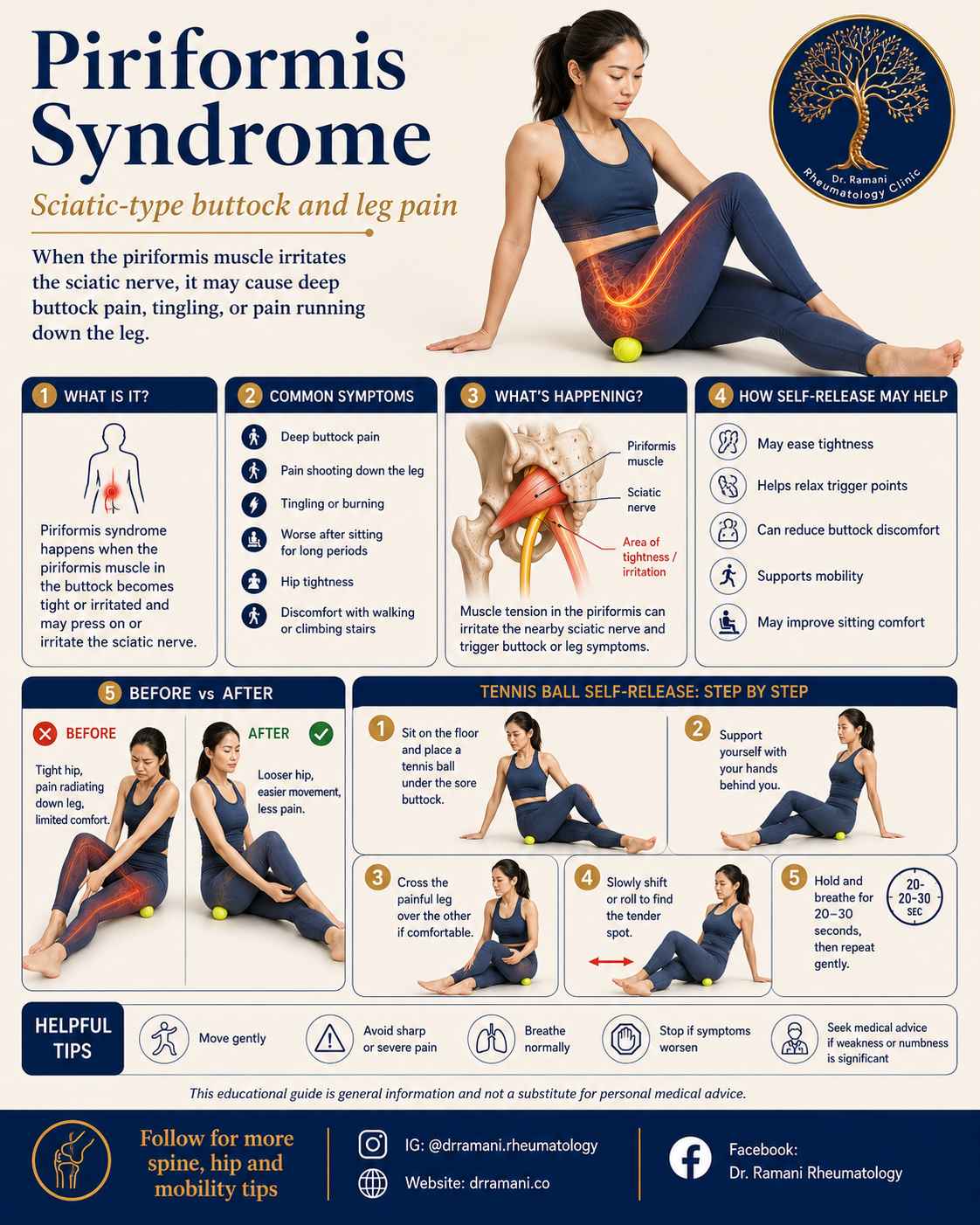
Patient guide from my clinic
What piriformis syndrome is
The piriformis is a small muscle deep in the buttock that helps rotate the hip. The sciatic nerve runs very close to it, and in some people passes right through the muscle. When the piriformis becomes tight, spasm-prone or irritated, it can compress or irritate the nearby sciatic nerve. This produces a pattern of deep buttock pain, sometimes with tingling or burning down the back of the leg. Symptoms are often triggered by prolonged sitting, a sudden increase in walking or running, driving long distances, hip weakness, or a fall onto the buttock. Piriformis-related pain can look and feel very similar to sciatica from a spinal disc problem, which is why the pattern of symptoms and a careful examination matter.
Symptoms to look out for
Deep buttock pain, often on one side
Pain shooting or radiating down the back of the leg
Tingling or a burning sensation in the buttock or leg
Symptoms that are worse after sitting for long periods
Tightness around the hip or buttock
Discomfort with walking, climbing stairs or getting out of a chair
Why this matters to a rheumatologist
Piriformis-type pain is common and usually mechanical, but I still want to rule out other causes that can look similar. Lumbar disc problems and nerve root irritation can produce very similar leg pain. Inflammatory sacroiliitis and hip joint problems can also present as deep buttock pain. In people with hypermobility, inflammatory arthritis or previous pelvic surgery, the picture can be more complex. My role is to work out whether the pain really is from the piriformis and its neighbours, or from the spine, the SI joint, the hip or an inflammatory condition, so treatment targets the right structure.
Signs I would like you to seek care for
For emergency symptoms please seek urgent or emergency care first rather than waiting for a WhatsApp reply.
New weakness in the leg or foot, or a foot that drags
Numbness around the groin or inner thighs, or loss of bladder or bowel control
Severe pain after a fall, road accident or heavy impact
Fever, unexplained weight loss or night sweats with buttock or back pain
Pain that keeps you awake at night or is not improving with rest and gentle activity
Calf swelling, redness or breathlessness, which need urgent assessment for a clot
What a specialist review looks like
In clinic I take a careful history of your symptoms, ask about work posture, driving, exercise and any past back or hip problems, then examine the lower back, SI joints, hip and buttock with specific tests. This helps separate piriformis-related pain from spinal, hip and inflammatory causes. I may arrange blood tests, X-rays or MRI when I want to exclude another cause or confirm the diagnosis. Treatment for piriformis syndrome is usually conservative and focuses on gentle self-release, stretching and strengthening, activity adjustment, and where needed suitable pain relief or physiotherapy referral. A tennis ball self-release, as shown in the guide, can be very helpful for many patients. Guided injections are considered in selected patients when symptoms do not settle with conservative care. If I find an underlying inflammatory or spinal cause, treatment is directed at that condition.
Questions my patients often ask me
Sciatica means pain along the sciatic nerve, whatever the cause. Piriformis syndrome is one cause of sciatic-type pain, where the nerve is irritated by the piriformis muscle in the buttock rather than by the spine. The treatment differs, so working out which one you have is important.
Speak with me
Buttock and leg pain can come from the piriformis, the spine, the SI joint or the hip. An assessment helps identify what is really driving your symptoms, so we can plan safe and effective treatment together.
Other conditions I treat
This page is for general education only and does not replace medical advice. Please consult a qualified healthcare professional for diagnosis and treatment.