
Trigger Finger
Trigger finger can make a finger or thumb feel stiff, painful or difficult to straighten, often with clicking, popping or a sudden catching sensation. Gentle exercises may help keep the finger moving, but a finger that repeatedly locks, becomes more painful, or comes with swollen joints should be properly assessed.
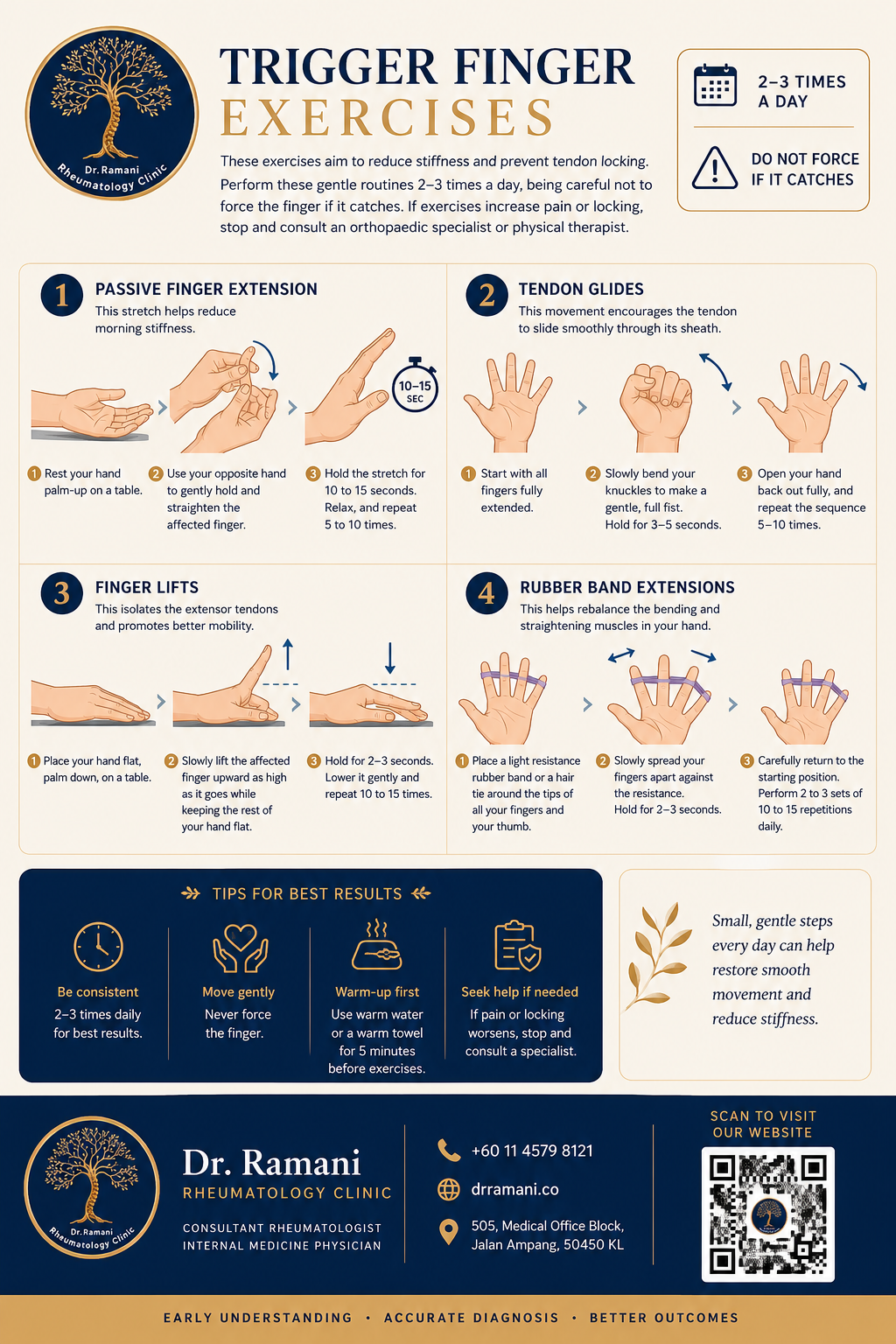
Gentle trigger finger exercises: 2 to 3 times a day, and never force a finger that catches.
What trigger finger is
Trigger finger, also called stenosing tenosynovitis, affects one of the tendons that bends your finger or thumb. Normally the tendon slides smoothly through a small tunnel called a tendon sheath. In trigger finger the tendon or the tunnel becomes thickened or narrowed, so the tendon catches as it moves and the finger clicks, locks or suddenly releases. It most often affects the ring finger or thumb, although any finger can be involved. In many people there is no single clear cause, but repeated or forceful gripping, frequent pinching, diabetes, rheumatoid arthritis and increasing age all make it more likely.
Symptoms to look out for
Clicking, popping or catching when bending or straightening the finger
A finger or thumb becoming stuck in a bent position
Stiffness that is worse in the morning
Pain or tenderness at the base of the finger
A small tender lump in the palm
Needing your other hand to straighten the affected finger
Difficulty gripping, preparing food, using tools or completing daily tasks
Why this matters to a rheumatologist
Trigger finger mainly affects a tendon and its sheath rather than the joint itself, so it is not usually a form of arthritis. It is more common, though, in people with rheumatoid arthritis, diabetes and other inflammatory conditions. I look at the whole pattern of your hand symptoms to work out whether the problem is mechanical, tendon related or part of a wider inflammatory picture. A rheumatology review is particularly useful when triggering comes with swollen finger, hand or wrist joints, prolonged morning stiffness, pain in several joints, symptoms in both hands, more than one affected finger, or known rheumatoid arthritis. Diagnosis is usually made by discussing your symptoms and examining the hand, looking for tenderness at the base of the finger, thickening around the tendon, catching during movement and any signs of arthritis nearby. X-rays and scans are not usually needed for straightforward trigger finger.
Signs I would like you to seek care for
For emergency symptoms please seek urgent or emergency care first rather than waiting for a WhatsApp reply.
Symptoms that are not improving, or a finger that repeatedly locks or catches
Pain interfering with work or daily activities
Needing your other hand to straighten the finger
More than one finger affected, or swollen joints and prolonged morning stiffness
Diabetes, rheumatoid arthritis or another inflammatory condition alongside the triggering
A finger completely locked in a bent position that cannot be straightened, which needs urgent review
A hand that becomes very painful, hot, swollen or red while you feel unwell, which needs urgent review
What a specialist review looks like
In clinic I examine the tendon and the surrounding joints, check for swelling and inflammation, and clarify whether this is a local tendon problem or part of something wider. Gentle exercises can help keep the finger mobile and encourage the tendon to glide: passive finger extension using the opposite hand, tendon glides moving from an open hand into a soft fist and back, finger lifts with the hand flat, and gentle rubber band finger extensions. Move slowly, stay within a comfortable range, and do not force a finger that catches or locks. Beyond exercises, treatment may include reducing repetitive gripping and pinching, a splint worn at night to keep the finger straighter, pain relief or anti inflammatory medicine where suitable, a corticosteroid injection around the tendon, or a trigger finger release with a hand or orthopaedic surgeon when symptoms persist. Where a wider inflammatory condition is found, I treat that alongside the hand problem and coordinate with physiotherapy or hand therapy.
Questions my patients often ask me
Some mild cases settle with time and less aggravating activity. Persistent locking, worsening pain or difficulty with daily tasks should be assessed.
Speak with me
If your finger repeatedly catches or locks, especially with swollen joints, prolonged morning stiffness or pain in several joints, WhatsApp my clinic and we can arrange an assessment to clarify what is causing it.
Other conditions I treat
This page is for general education only and does not replace medical advice. Please consult a qualified healthcare professional for diagnosis and treatment.