
Psoriatic Arthritis: When to Refer to a Rheumatologist
A concise referral guide for general practitioners. The signs to recognise in primary care, red flags that need urgent review, and how to refer a suspected psoriatic arthritis patient to my clinic.
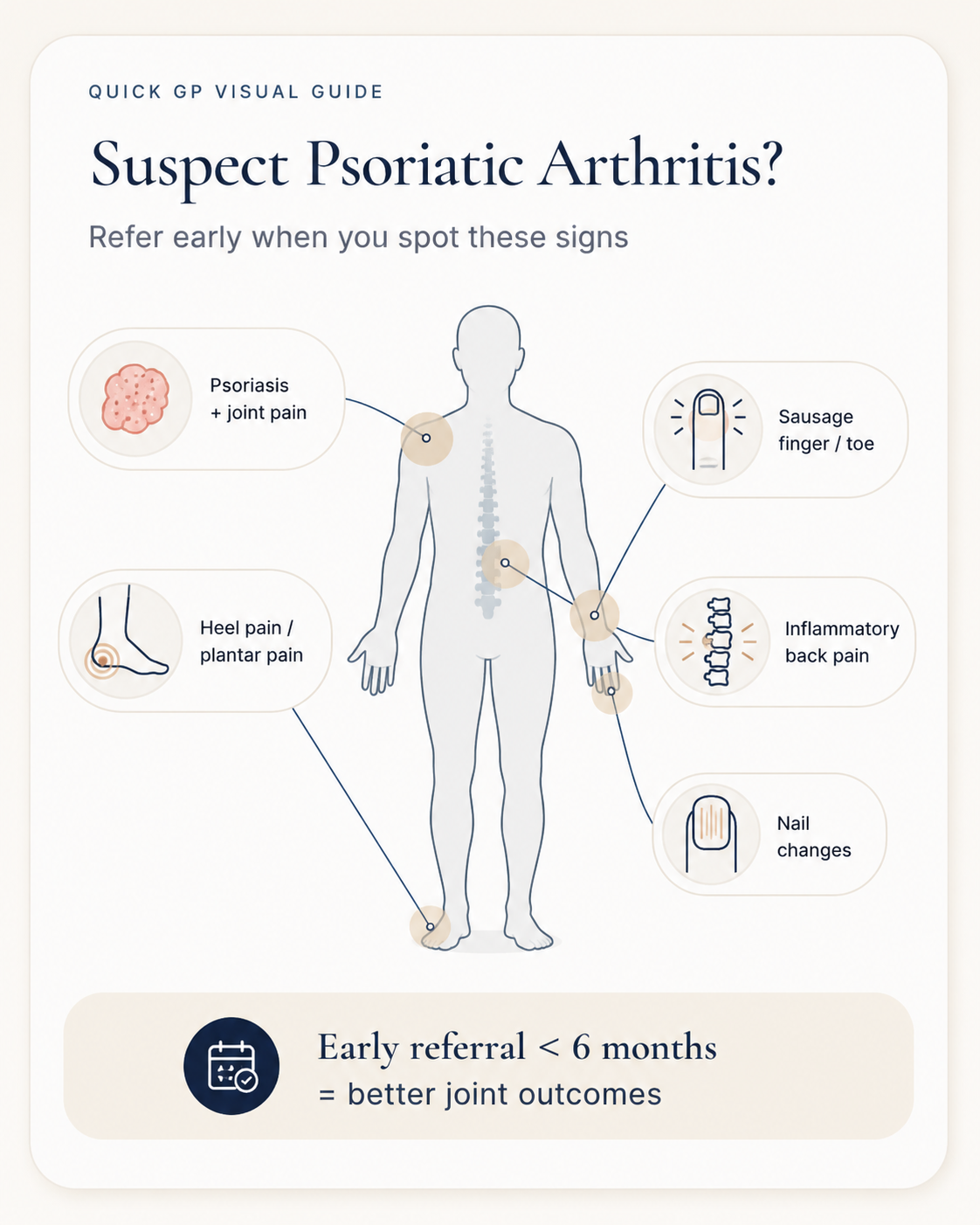
Why early referral matters in psoriatic arthritis
Psoriatic arthritis is an inflammatory joint disease linked to psoriasis. It can affect peripheral joints, the axial skeleton, tendons and entheses, and may cause progressive joint damage if not treated.
Up to 30% of patients with psoriasis develop psoriatic arthritis, and joint involvement may appear before, with, or after skin disease. Many cases are missed in primary care because joint symptoms are attributed to mechanical pain or osteoarthritis.
When in doubt, please refer. I would rather review a patient and reassure them than miss an early window for treatment.
Signs and symptoms to recognise in primary care
Any combination of the following, especially with personal or family history of psoriasis, should raise suspicion of psoriatic arthritis. The pattern is often more useful than any single feature.
Joint pain and stiffness
Aching or painful joints, often asymmetric. Distal interphalangeal joints are characteristically involved.
Joint swelling
Fingers, toes or other joints may look puffy and tender, beyond what mechanical pain would explain.
Morning stiffness
Stiffness lasting more than 30 minutes after waking, easing with movement, suggests an inflammatory pattern.
Dactylitis
Whole digit swelling (sausage finger or toe) is highly suggestive of psoriatic arthritis.
Enthesitis and heel pain
Pain at tendon insertions, particularly the Achilles tendon and plantar fascia.
Foot pain on walking
Persistent forefoot or midfoot pain in someone with psoriasis warrants further assessment.
Skin plaques and scalp psoriasis
Scaly plaques on the scalp, hairline, elbows, knees or umbilicus. Ask and examine, including hidden areas.
Nail pitting or onycholysis
Small dents, ridging, separation of the nail plate, or oil drop changes can occur with psoriatic arthritis.
Inflammatory back pain
Insidious onset before age 45, night pain, morning stiffness, and improvement with activity.
Fatigue and flare pattern
Many patients describe periods of worsening symptoms followed by partial improvement.
Features that warrant urgent rheumatology input
If any of the following are present, please WhatsApp the clinic directly so we can arrange an early review or, where appropriate, advise emergency department assessment.
- Red flagHot, swollen single joint with fever (rule out septic arthritis first)
- Red flagNew onset inflammatory back pain with neurological symptoms
- Red flagRapidly progressive joint swelling or deformity
- Red flagSuspected uveitis (red painful eye, photophobia, blurred vision)
- Red flagGeneralised pustular psoriasis or severe erythrodermic psoriasis
- Red flagPatient already on biologic therapy with new flare or infection
When to refer to me
- Patient with psoriasis and any new persistent joint pain, swelling or stiffness
- Dactylitis or enthesitis at any age
- Inflammatory back pain pattern, especially before age 45
- Asymmetric oligoarthritis without an obvious mechanical cause
- Nail changes (pitting, onycholysis) plus joint symptoms
- Strong family history of psoriasis or spondyloarthritis with suggestive joint symptoms
- Failure to respond to a short course of NSAIDs in suspected inflammatory joint pain
- Do not wait for blood tests to come back before referring
- Do not wait for x-ray erosions, by then damage may already be established
- Do not assume negative RF or anti-CCP rules out inflammatory arthritis
- Do not start steroids before referral, especially intra-articular injections, as they mask the disease and make diagnosis difficult
Initial workup to consider before referral
These are helpful if easily available, but please do not delay referral while waiting for results. I am happy to organise the rest at the first consultation.
Bloods
- FBC, LFT, renal profile
- ESR, CRP
- Uric acid, UFEME
- RF, anti-CCP (often negative in PsA, but useful baseline)
- Hepatitis B, Hepatitis C and HIV screening if DMARDs or biologics are being considered
Imaging
- Plain x-rays of symptomatic joints: hands and feet 2 views (AP and lateral), knees 6 views (AP, lateral and merchant / skyline views of both knees)
- If axial or buttock symptoms, request sacroiliac joint x-rays: 2 views (pelvis AP and sacroiliac oblique)
- Ultrasound or MRI is usually arranged at specialist level
Examination notes to share
- Pattern of joint involvement (axial, peripheral, symmetry)
- Presence of dactylitis or enthesitis
- Skin and nail examination findings
- Eye symptoms or any history of uveitis
What to include in the referral letter
A short, structured referral helps me triage urgency and prepare the right investigations before the patient arrives.
- Patient name, age, contact number and MRN if available
- Brief presenting complaint and duration of symptoms
- Joint distribution and any dactylitis or enthesitis noted
- Personal or family history of psoriasis and any skin or nail findings
- Past medical history and current medications, including over the counter NSAIDs
- Allergies, smoking status, and pregnancy or breastfeeding status if relevant
- Any investigations already done, with results or report attached
- Urgency level and your preferred contact details
How to refer a patient to my clinic
The fastest way is to WhatsApp the clinic with a short summary. The clinic team will coordinate scheduling and triage urgent referrals to an earlier slot where needed.
- 1
Send a short WhatsApp message with the patient's summary, joint pattern, and contact number.
- 2
Attach any relevant blood results, imaging, or your referral letter.
- 3
The clinic team responds within working hours and offers an appointment based on urgency.
- 4
The patient is reviewed at Dr Ramani Rheumatology Clinic
- 5
A summary of findings and the plan is sent back to you after the consultation.
GP questions I am often asked about psoriatic arthritis
Have a patient you would like to refer?
Please WhatsApp the clinic with a short summary. I will prioritise suspected inflammatory arthritis and respond as soon as I can.
Related doctor guides and resources
More referral and shared care guides are on the way. These will be linked here as they become available.