
Low Back Pain: When to Refer to Rheumatology
A simple guide to assessment, management and when to refer. Most low back pain is mechanical and settles with conservative care, but a small group of patients have inflammatory back pain that is missed for years.
I see patients whose axial spondyloarthritis was diagnosed only after a long delay. Early recognition of inflammatory back pain prevents that delay and reduces long-term impact, so this guide sets out the red flags, the inflammatory features worth screening for, and what I need from a referral.
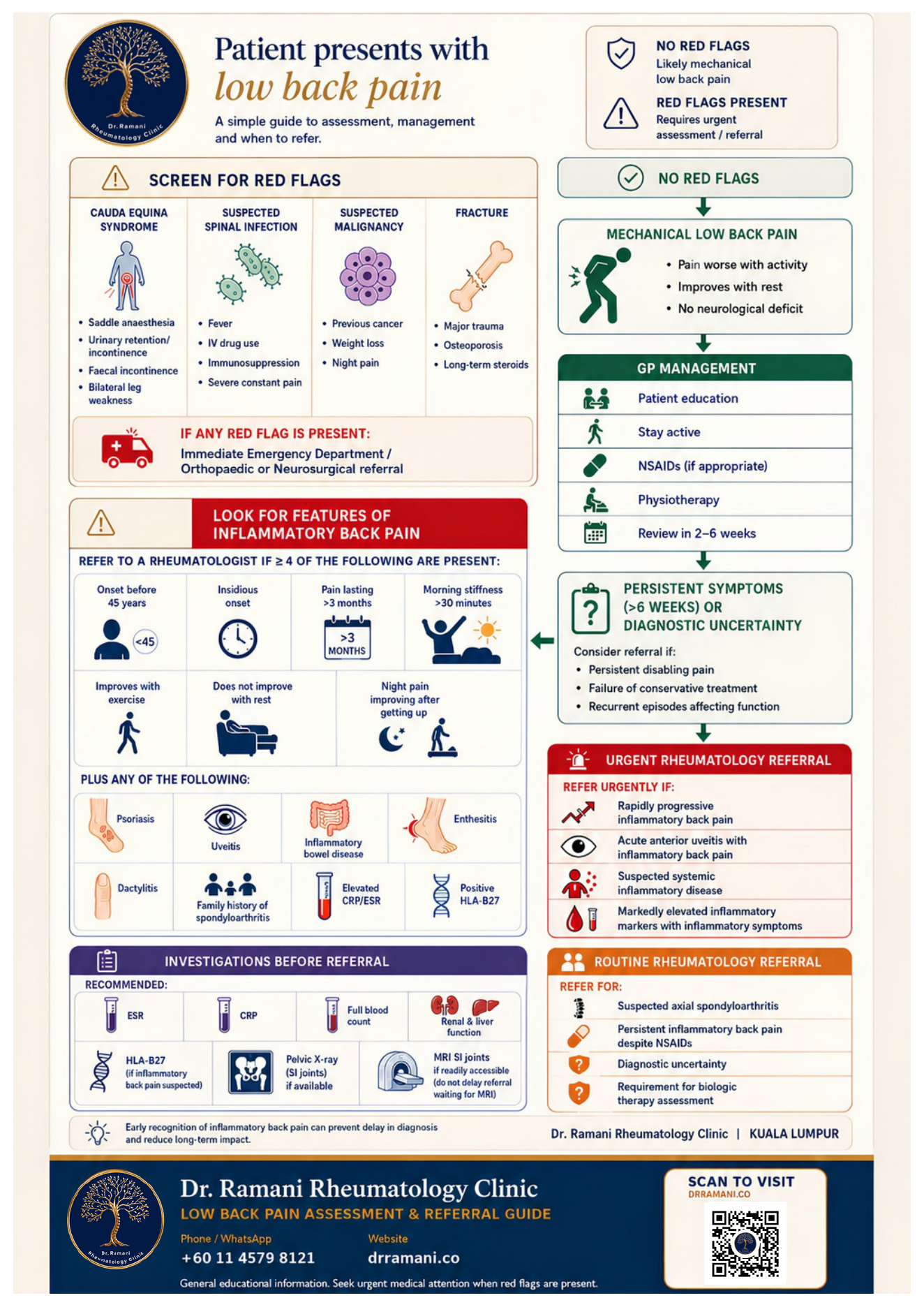
One-page clinician guide. Tap to open the PDF.
Low Back Pain in Primary Care: my talk slides
I spoke on Low Back Pain in Primary Care: Assessment, Red Flags and First-Line Management for GPs at Connecting Skin and Joint Care in Primary Care, a GP education event held on 1 August 2026 at Royale Chulan Damansara. Several colleagues asked for the slides afterwards, so I am sharing the full deck here for your reference.
These slides are shared for medical education among healthcare professionals and are not a substitute for clinical judgement.
Screen for red flags
Before considering the cause of the pain, rule out the presentations that need urgent care. Most of these are not rheumatology referrals.
- Saddle anaesthesia
- Urinary retention or incontinence
- Faecal incontinence
- Bilateral leg weakness
- Fever
- IV drug use
- Immunosuppression
- Severe constant pain
- Previous cancer
- Weight loss
- Night pain
- Major trauma
- Osteoporosis
- Long-term steroids
A suspected osteoporotic vertebral fracture without neurological signs can be referred to me for fracture risk assessment and bone protection.
- Cauda equina syndrome, suspected spinal infection, suspected malignancy, or fracture with major trauma or new neurological signs: arrange immediate Emergency Department, orthopaedic or neurosurgical referral. Do not delay for imaging or blood tests in primary care.
- Suspected fragility or osteoporotic vertebral fracture with no neurological signs: refer to me. I will confirm the fracture, assess fracture risk and start bone protection.
Look for features of inflammatory back pain
Refer to me if four or more of the following are present. This is the single most useful screen a GP can apply in a back pain consultation.
- Onset before 45 years
- Insidious onset
- Pain lasting more than 3 months
- Morning stiffness more than 30 minutes
- Improves with exercise
- Does not improve with rest
- Night pain that improves after getting up
- Psoriasis
- Uveitis
- Inflammatory bowel disease
- Enthesitis
- Dactylitis
- Family history of spondyloarthritis
- Elevated CRP or ESR
- Positive HLA-B27
Early recognition of inflammatory back pain can prevent delay in diagnosis and reduce long-term impact.
Mechanical low back pain and GP management
- Pain worse with activity
- Improves with rest
- No neurological deficit
- Patient education
- Stay active
- NSAIDs if appropriate
- Physiotherapy
- Review in 2 to 6 weeks
Consider referral if:
- Persistent disabling pain
- Failure of conservative treatment
- Recurrent episodes affecting function
Investigations that help me
These are helpful when available, but please do not delay a referral while waiting for results.
- ESR
- CRP
- Full blood count
- Renal and liver function
- HLA-B27 if inflammatory back pain is suspected
- Pelvic X-ray of the sacroiliac joints if available
- MRI of the sacroiliac joints if readily accessible, but do not delay referral waiting for MRI
When to refer to me
- Rapidly progressive inflammatory back pain
- Acute anterior uveitis with inflammatory back pain
- Suspected systemic inflammatory disease
- Markedly elevated inflammatory markers with inflammatory symptoms
- Suspected osteoporotic or fragility fracture of the spine without red neurology
- Suspected axial spondyloarthritis
- Persistent inflammatory back pain despite NSAIDs
- Diagnostic uncertainty
- Requirement for biologic therapy assessment
Download the referral guide
- One-page assessment pathway
- Red flag screen
- Inflammatory back pain checklist
- Urgent and routine referral triggers
Tap the preview to open full size, or use the buttons above to save a copy.
Common referral questions
How many inflammatory back pain features justify a referral?
Four or more of the seven features, particularly in someone under 45 with symptoms lasting more than three months, should prompt a rheumatology referral.
Does a normal CRP or ESR exclude axial spondyloarthritis?
No. Inflammatory markers are normal in a significant proportion of patients with axial spondyloarthritis, so normal results should not delay referral when the clinical pattern fits.
Should I wait for an MRI before referring?
No. Order an MRI of the sacroiliac joints if it is readily accessible, but do not delay referral while waiting for it.
Is HLA-B27 a diagnostic test?
No. It is a supporting feature, not a diagnostic test. A positive result raises the likelihood of spondyloarthritis but does not confirm it, and a negative result does not exclude it.
What should I do if red flags are present?
Red flags for cauda equina syndrome, spinal infection, malignancy or fracture need immediate Emergency Department, orthopaedic or neurosurgical referral rather than a routine rheumatology referral.
How long should conservative management continue before referral?
For mechanical low back pain, review in two to six weeks. Consider referral if symptoms persist beyond six weeks, remain disabling, or recur in a way that affects function.
Educational · Not a diagnosis. This page is a clinical education guide for doctors and is not a substitute for clinical judgement or a complete diagnostic or treatment guideline. Seek urgent medical attention when red flags are present. All content is medically reviewed and approved by Dr Ramani Arumugam, Consultant Rheumatologist and Internal Medicine Physician at Dr Ramani Rheumatology Clinic.