
Golimumab
Also known as: Simponi · Simponi Aria
Golimumab is a biological therapy that helps reduce inflammation, pain and joint damage. It is not a painkiller, so it works gradually. Many of my patients start to feel better after about 8 to 12 weeks.
Calm, careful medication review by a consultant rheumatologist.
Golimumab: a guide for patients
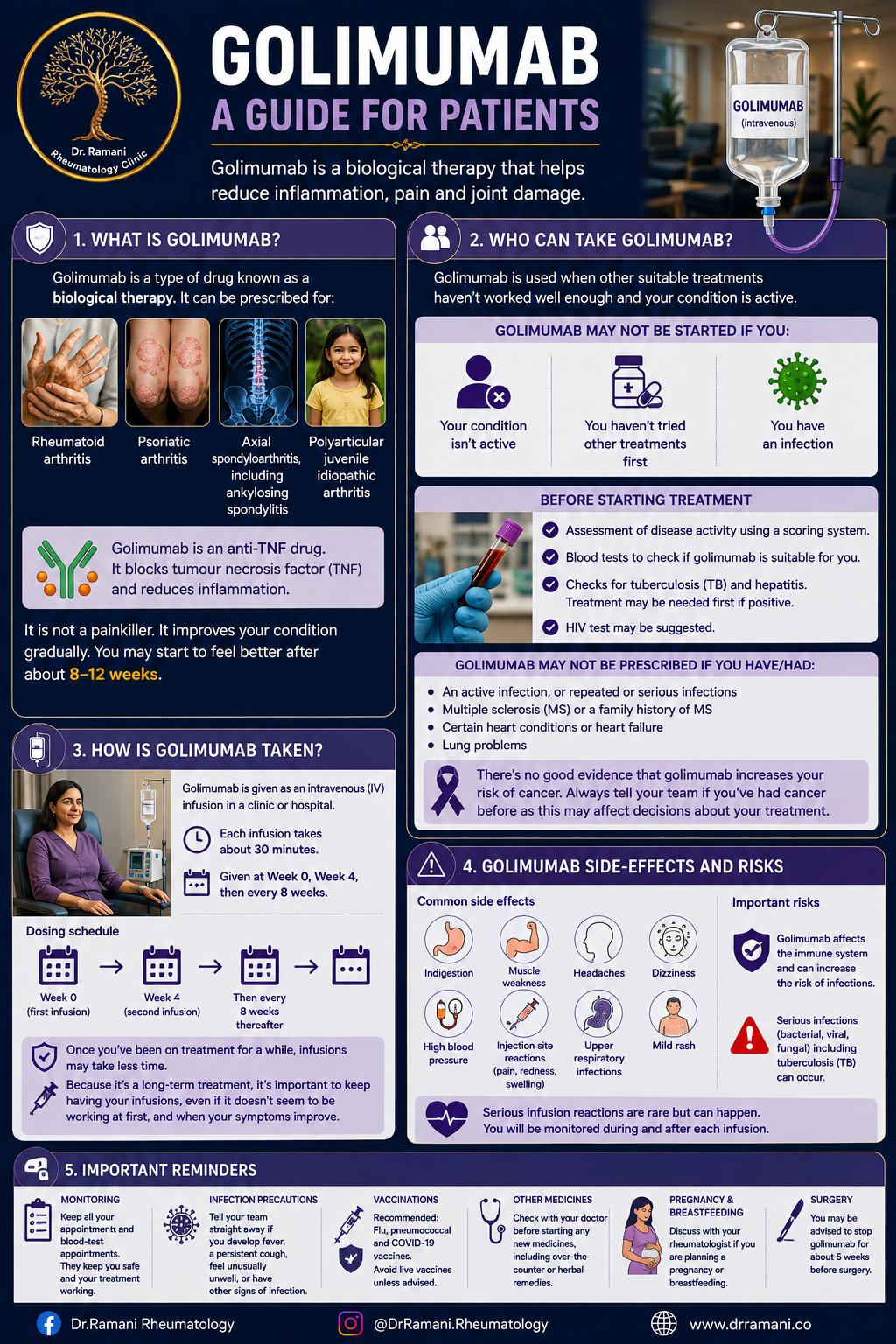
Tap the image to open the full-size version you can save or print.
For nurses and infusion staff
This is the two-page pack I use for golimumab infusions in day-care. Page one is the physician order and nursing checklist covering pre-infusion screening, dose and the infusion rate steps. Page two is the infusion monitoring chart for vitals and reaction checks. Nurses are welcome to print it for use in the infusion room.
What this medicine is
Golimumab is an anti-TNF drug. It blocks tumour necrosis factor (TNF), one of the main inflammatory signals driving your joint disease. I use it when your condition is active and other suitable treatments have not worked well enough.
Uses and context
I prescribe golimumab for rheumatoid arthritis, psoriatic arthritis, axial spondyloarthritis including ankylosing spondylitis, and polyarticular juvenile idiopathic arthritis.
How this relates to rheumatology care
Golimumab is given as an intravenous infusion in a clinic or hospital, over about 30 minutes. The schedule is Week 0, Week 4, then every 8 weeks. Once you have been on treatment for a while, infusions may take less time. Because this is a long-term treatment, I ask you to keep coming for your infusions even if it does not seem to be working at first, and also once your symptoms improve.
What safety checks may matter
Assessment of your disease activity using a scoring system
Blood tests to check that golimumab is suitable for you
Screening for tuberculosis (TB) and hepatitis; treatment may be needed first if positive
An HIV test may be suggested
Vaccination review, including flu, pneumococcal and COVID-19 vaccines
Side effects and red flags
If you have emergency symptoms such as severe allergic reaction, breathing difficulty, chest pain, stroke-like symptoms, severe abdominal pain, vomiting blood, black stools, sudden vision loss, severe infection symptoms, or severe weakness or confusion, please seek urgent medical care first rather than waiting for a WhatsApp reply.
Fever, a persistent cough, or feeling unusually unwell
Any other sign of infection: tell my team straight away
New or worsening breathlessness or swelling of the legs
Signs of an infusion or allergic reaction during or after treatment
Things worth knowing day to day
Golimumab may not be started if your condition is not active, if other treatments have not been tried first, or if you have an infection.
It may not be prescribed if you have or have had an active or repeated serious infection, multiple sclerosis or a family history of MS, certain heart conditions or heart failure, or lung problems.
Avoid live vaccines unless I advise otherwise.
Check with me before starting any new medicine, including over-the-counter and herbal remedies.
You may be advised to stop golimumab for about 5 weeks before surgery.
Discuss with me if you are planning a pregnancy or breastfeeding.
There is no good evidence that golimumab increases your risk of cancer, but always tell me if you have had cancer before as this may affect treatment decisions.
Questions patients often ask me about this medicine
Speak with me
If golimumab has been suggested for you, please message my clinic. I will go through the checks, the infusion schedule and what to expect.
Other medications used in rheumatology care
This page is for general education only and does not replace medical advice. Please consult a qualified healthcare professional for diagnosis and treatment. Do not start, stop, or change any medicine without advice from your doctor.