
Frozen Shoulder
Frozen shoulder, also called adhesive capsulitis, causes pain and progressive stiffness in the shoulder. Reaching overhead, putting on clothes, fastening a bra or sleeping on the affected side can gradually become difficult. A proper assessment helps confirm whether the problem is frozen shoulder or another cause of shoulder pain.
Frozen shoulder at a glance
The symptoms, what is happening inside the shoulder, who tends to get it, and six gentle exercises that may help. Move within comfort and stop if pain becomes sharp.
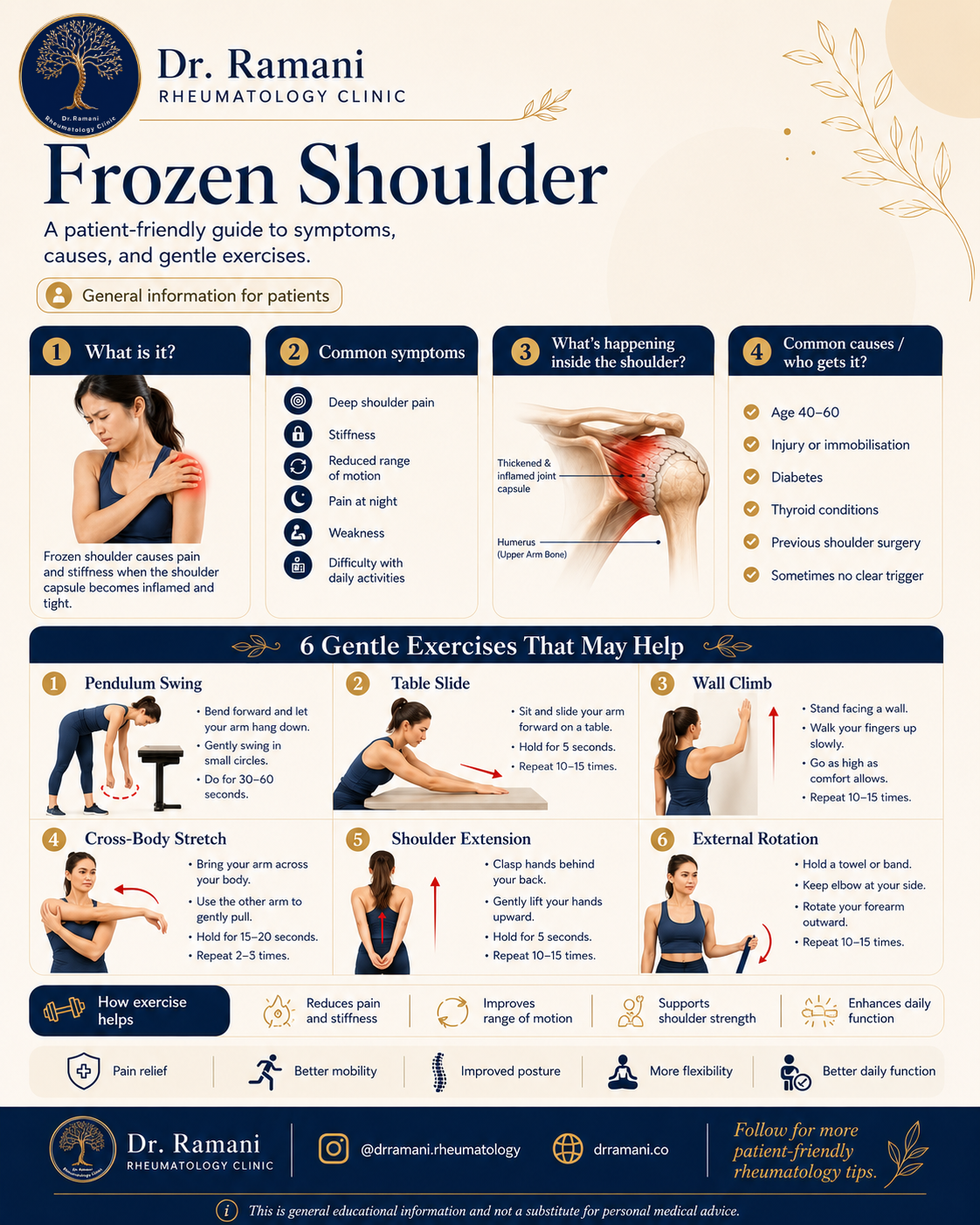
Open the full-size infographic
For my step-by-step routine with holding times, jump to the four gentle stretches further down this page.
Why gentle movement helps a frozen shoulder
In a frozen shoulder the capsule around the joint becomes inflamed, thickened and tight, so the shoulder has less room to move. Keeping the arm completely still feels protective, but it usually allows the stiffness to settle in further. Regular gentle movement keeps as much range as possible while the shoulder works through its natural course.
The aim is not to force the shoulder open. You should feel a stretch and mild discomfort that settles quickly once you stop. Sharp pain, or pain that leaves the shoulder more irritable the following morning, means the movement was too aggressive and should be scaled back.
Four stretches to work through
Warm the shoulder first, for example with a warm shower or a warm pack, then move slowly and within comfort. If you can only manage the pendulum swing at first, start there.
Pendulum stretch
Lean over slightly and let your affected arm hang down. Swing the arm in small circles, or gently back and forth. Use your body momentum rather than your shoulder muscles.
Do this 10 to 15 times.
Wall crawl
Stand facing a wall about three-quarters of an arm's length away. Touch the wall with your fingertips, then slowly walk your fingers up the wall until you feel a stretch.
Hold for 5 seconds, then lower down.
Towel stretch
Hold a towel about three feet long behind your back with both hands. Use your good arm to gently pull the stiff arm upward.
Hold for 15 seconds.
Cross-body stretch
Sit or stand. Use your good hand to lift the affected arm at the elbow, then draw it gently across your chest towards the opposite shoulder.
Hold for 15 seconds.
How to fit this into your day
Little and often
Aim to do these movements 3 to 5 times every day rather than once in a while.
Short sessions win
Several short sessions are usually better tolerated than one long workout.
Expect slow progress
Improvement in a frozen shoulder is measured over several weeks or months, not days.
Be patient and consistent. Small steps today lead to greater movement tomorrow.
Signs that need assessment rather than more stretching
Sharp or severe pain during the movements, or pain that lingers long after you stop
A red, hot or markedly swollen shoulder, especially with fever
New weakness, numbness or tingling in the arm or hand
A significant fall or injury to the shoulder, or sudden inability to move the arm
Chest pain, breathlessness or pain spreading to the jaw, which needs urgent attention
Movement that is not improving at all after several weeks, or pain and swelling appearing in other joints
These stretches are for general education and may not be suitable after a recent shoulder injury or surgery, or with certain medical conditions. Please check with me or another qualified healthcare professional if you are uncertain about your symptoms or how to exercise safely.
What frozen shoulder is
The shoulder is surrounded by a flexible tissue called the joint capsule. In frozen shoulder, this capsule becomes inflamed, thickened and tight, which reduces the space available for movement. Symptoms often develop gradually rather than appearing all at once, and typically move through three broad stages. In the freezing stage, pain builds up and movement begins to reduce, with night pain that can be particularly troublesome. In the frozen stage, pain may ease but stiffness remains and dressing, reaching and daily activities can still be difficult. In the thawing stage, movement gradually returns, though recovery is often slow and varies from person to person. The stages are not always clearly separated, and every patient's experience is different.
Symptoms to look out for
Deep or aching shoulder pain that is often worse at night
Gradually increasing stiffness in the shoulder
Reduced range of movement when you move the arm yourself and when someone moves it for you
Difficulty reaching a high shelf, combing or washing your hair, or putting on a shirt
Trouble reaching behind your back, driving comfortably or sleeping on the affected side
Symptoms that develop gradually rather than after a single injury
Why this matters to a rheumatologist
Frozen shoulder can occur without an obvious reason, but several factors are associated with a higher risk, including age around 40 to 60, diabetes, thyroid conditions, a previous shoulder injury or surgery, and periods when the arm had to be kept still. It is not simply caused by using the shoulder too much or by poor posture. Shoulder pain and stiffness can also come from rotator cuff problems, arthritis, referred neck pain or inflammatory joint disease, so my job is to work out which pattern fits you. This matters because inflammatory arthritis and some autoimmune conditions can affect the shoulder too, and identifying them early guides very different treatment.
Signs I would like you to seek care for
For emergency symptoms please seek urgent or emergency care first rather than waiting for a WhatsApp reply.
A significant shoulder injury or visible deformity, or sudden inability to move the arm
A red, hot or markedly swollen shoulder with fever
Chest pain, breathlessness, sweating or pain spreading to the jaw
New or worsening weakness, numbness or loss of sensation in the arm
Shoulder pain and stiffness that are not improving, disturbing your sleep, or making dressing, bathing or driving difficult
Both shoulders affected, or pain and swelling in other joints too
What a specialist review looks like
In clinic I start with a careful discussion of your symptoms and medical history, then examine how far the shoulder moves when you move it yourself and when I move it for you. I look at the neck, the surrounding tendons and the other joints, and consider conditions that can mimic frozen shoulder. Imaging such as X-ray, ultrasound or MRI is not always needed to diagnose frozen shoulder, but may be arranged when I want to exclude another cause. Treatment is tailored to the stage and severity, and usually focuses on controlling pain, keeping safe movement going, and gradually restoring function. This may include education and activity adjustment, suitable pain relief, gentle stage-appropriate movement, a physiotherapy programme, and in selected patients a corticosteroid injection to reduce pain and inflammation. Most people are managed without surgery, and further specialist procedures are only considered when symptoms remain severe despite appropriate conservative care.
Questions my patients often ask me
No. Frozen shoulder primarily affects the capsule surrounding the shoulder joint, not the joint cartilage. Arthritis and several other conditions can also cause shoulder pain and stiffness, so an assessment may be needed to tell them apart.
Speak with me
Shoulder pain and stiffness can have more than one cause. An assessment can help determine whether your symptoms are due to frozen shoulder or another shoulder, joint or inflammatory condition, so we can plan the right next step together.
Other conditions I treat
This page is for general education only and does not replace medical advice. Please consult a qualified healthcare professional for diagnosis and treatment.