
Ankylosing Spondylitis
Back pain that starts in your teens, twenties or thirties, feels stiff in the morning and improves with movement is not the same as ordinary mechanical back pain. If this sounds familiar, especially with heel pain, eye redness or a family history of similar problems, I would like to review you before the pattern is dismissed as a simple bad back.
Ankylosing spondylitis at a glance
Core symptoms, causes, complications and treatment options, with Malaysian data on how AS presents locally and how long diagnosis often takes.
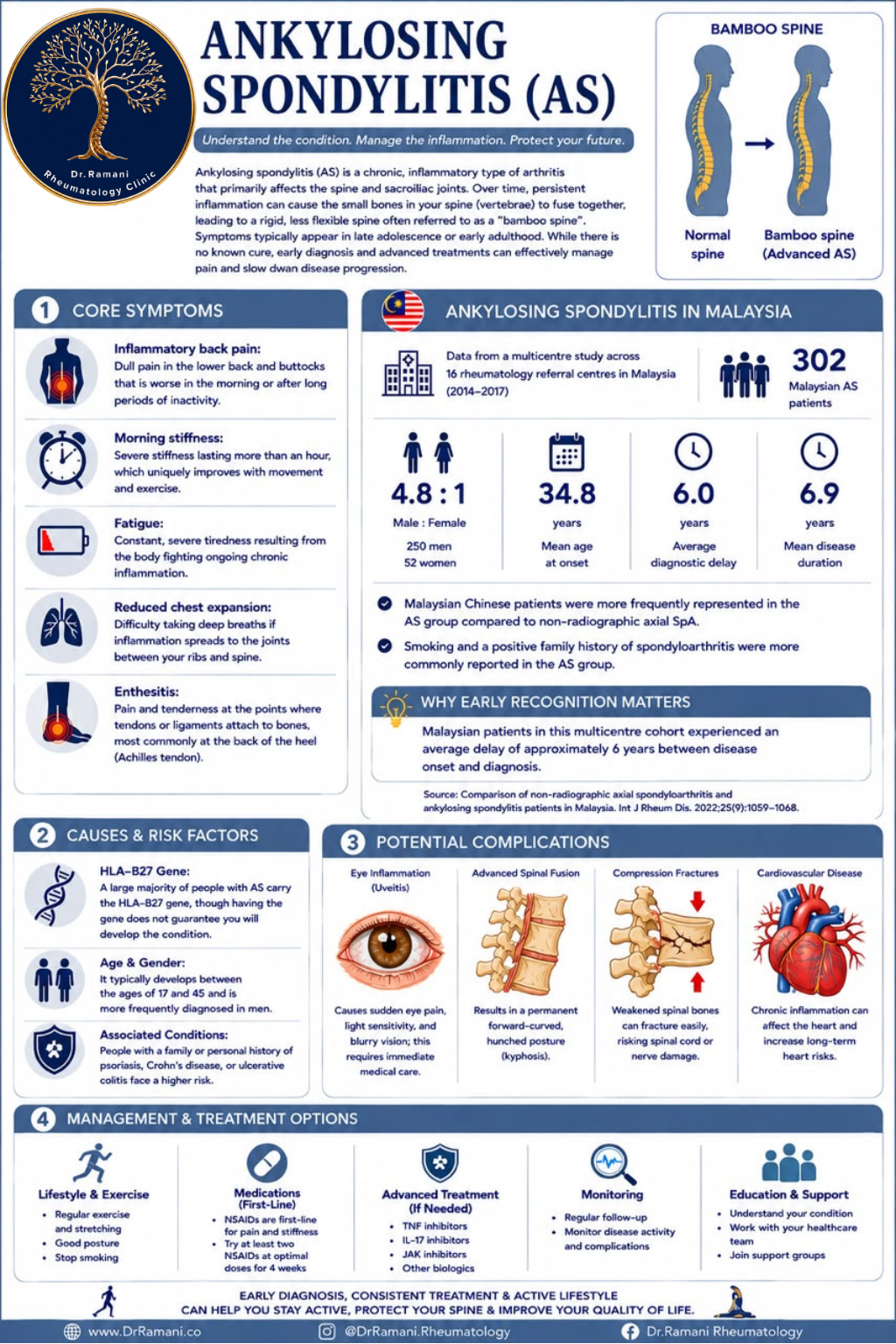
Open the full-size infographic
My research on ankylosing spondylitis
I co-authored a study comparing juvenile-onset and adult-onset ankylosing spondylitis, looking at which clinical, functional and genetic factors predict a poorer outcome. It is one reason I pay close attention to back pain that started in the teenage years.
Jadon D, Hunt L, Arumugam R, Ramanan A, Sengupta R. Prognostic markers in juvenile vs. adult-onset ankylosing spondylitis. Annals of the Rheumatic Diseases 2013;72(Suppl 3):A522.
Read the abstract in Annals of the Rheumatic DiseasesChest expansion reference table
In axial spondyloarthritis I measure chest expansion because inflammation at the costovertebral and costosternal joints can restrict how far the rib cage moves. Reduced expansion is only meaningful when compared against normal values for age and sex, so I use this reference table in clinic. It covers circumferential and antero-posterior chest expansion from age 15 upwards.
This is a clinical reference sheet for doctors, nurses and physiotherapists. If you are a patient, please do not use it to diagnose yourself. Bring your concerns to me and I will examine you properly.
Download the normal chest expansion reference table (PDF)What ankylosing spondylitis is
Ankylosing spondylitis is a form of axial spondyloarthritis. It causes inflammation in the spine and sacroiliac joints, and sometimes in other joints and tendon insertion points. Symptoms usually begin between the teenage years and the mid-forties, and they can fluctuate over time. With the right diagnosis and treatment, most patients keep working, exercising and living well.
Symptoms to look out for
Lower back or buttock pain lasting more than three months
Morning stiffness that eases with movement rather than rest
Pain waking you in the second half of the night
Heel pain, rib pain or swollen finger or toe (dactylitis)
Recurring red painful eye (uveitis)
Psoriasis or inflammatory bowel symptoms
Family history of ankylosing spondylitis or psoriasis
Why this matters to a rheumatologist
As a rheumatologist, I look at the pattern of your back pain very carefully. Inflammatory back pain in a young adult can be the first sign of axial spondyloarthritis, and early recognition matters. I use a focused history, examination of the spine and related joints, targeted blood tests such as HLA-B27, ESR and CRP, and imaging of the sacroiliac joints where relevant. Early treatment can protect movement, posture and quality of life.
Signs I would like you to seek care for
For emergency symptoms please seek urgent or emergency care first rather than waiting for a WhatsApp reply.
New back pain before age 45 that has lasted more than three months
Stiffness that is worse after rest and better with activity
A red painful eye or new light sensitivity, which needs same day eye assessment
Back pain with psoriasis, inflammatory bowel symptoms or a strong family history
Rapidly worsening back or neck pain, or new weakness or numbness in the limbs
What a specialist review looks like
In clinic I listen to how your back behaves through the day and night, examine your spine and hips, and check your eyes, skin and other joints where relevant. Where it helps, I arrange targeted blood tests and imaging. If the pattern points to axial spondyloarthritis, I explain the diagnosis clearly and build a plan that may include structured exercise, physiotherapy, NSAIDs and, when appropriate, advanced therapy such as biologics.
Questions my patients often ask me
No. It is a form of inflammatory arthritis affecting the spine and sacroiliac joints, and it is assessed and treated differently from muscle strain or disc pain.
Speak with me
If your back pain started young, is worse at night, stiffens you in the morning, or comes with eye or skin symptoms, please seek specialist care. I would like to help you find the cause and the right plan.
Low Back Pain: When to Refer to Rheumatology
A one-page guide for GPs covering red flags, inflammatory back pain features and referral triggers.
Open the referral guideOther conditions I treat
This page is for general education only and does not replace medical advice. Please consult a qualified healthcare professional for diagnosis and treatment.