
Achilles tendon pain can improve with the right approach.
Pain or stiffness at the back of the heel can make walking, climbing stairs and exercising uncomfortable. The good news is that many cases of Achilles tendinopathy can improve with gradual, appropriately planned rehabilitation.
My 3-phase Achilles rehab program. Tap to enlarge.
What does the Achilles tendon do?
The Achilles tendon is the strong band of tissue that connects the calf muscles to the heel bone. It helps you lift your heel from the ground and provides the push-off power needed for walking, running, climbing stairs and jumping.
When the tendon is repeatedly exposed to more load than it can currently tolerate, it may become painful, stiff and less able to perform normally. This is known as Achilles tendinopathy.
Walking
The Achilles tendon helps propel your body forward with every step.
Stairs and rising
It helps lift your heel when climbing stairs or rising onto your toes.
Running and jumping
It stores and releases energy during faster or more demanding movement.
What does Achilles tendinopathy feel like?
Symptoms can vary depending on the location and severity of the tendon problem.
Pain or tenderness at the back of the ankle or heel
Stiffness when taking the first few steps in the morning
Pain when walking uphill, climbing stairs, running or jumping
Discomfort when rising onto the toes
Thickening or swelling around the tendon
Pain at the beginning of activity that temporarily eases as the tendon warms up
Pain or stiffness that becomes worse later in the day or the morning after activity
Reduced calf strength or difficulty pushing off while walking
Where is your pain?
Mid-portion Achilles tendinopathy
Pain is usually felt approximately 2 to 6 centimetres above the heel bone, within the main body of the tendon.
Insertional Achilles tendinopathy
Pain is felt where the tendon attaches directly to the heel bone. Some stretching and heel-drop exercises may need to be modified because lowering the heel below the level of a step can compress and aggravate this area.
Why might the Achilles tendon become painful?
Achilles tendinopathy usually develops when the tendon is exposed to a sudden increase in demand or does not have enough time to recover. It can affect active people, but it is not limited to athletes.
- A sudden increase in walking, running or sports
- Increasing exercise intensity or distance too quickly
- Returning to activity after a long break
- Repetitive uphill walking or running
- Tight or weak calf muscles
- A change in footwear or training surface
- Reduced recovery between activities
- Higher body weight or metabolic health conditions
- Certain inflammatory or rheumatic conditions
- Some medicines that can affect tendon health
Sometimes there is no single obvious cause. A proper assessment considers your symptoms, activity level, health conditions, medication history and the exact location of the pain.
Complete rest is not always the answer.
Reducing activities that clearly aggravate the tendon may help settle symptoms, but avoiding all movement for a long period can reduce the tendon's strength and capacity further.
The goal is usually to find a manageable level of activity and then rebuild strength gradually.
Reduce aggravating load
Temporarily reduce running, jumping, steep hills or prolonged walking if these clearly worsen your symptoms. Where comfortable, lower-impact activities such as cycling or swimming may help you remain active.
Wear supportive footwear
Choose comfortable, supportive shoes. Avoid suddenly switching to very flat, unsupportive footwear if this increases your pain.
Begin controlled loading
Start with exercises that you can perform with good control. Progress only when your symptoms remain manageable.
Monitor the next morning
A mild, temporary increase in discomfort may occur during rehabilitation. However, symptoms should settle back towards their usual level by the following morning. Persistent worsening means the exercise or activity may need to be reduced or modified.
A gradual 3-phase rehabilitation approach
The exercises below are designed to move from pain-calming holds to flexibility work and progressive tendon strengthening. They are a general educational starting point and are not a substitute for an individual assessment.
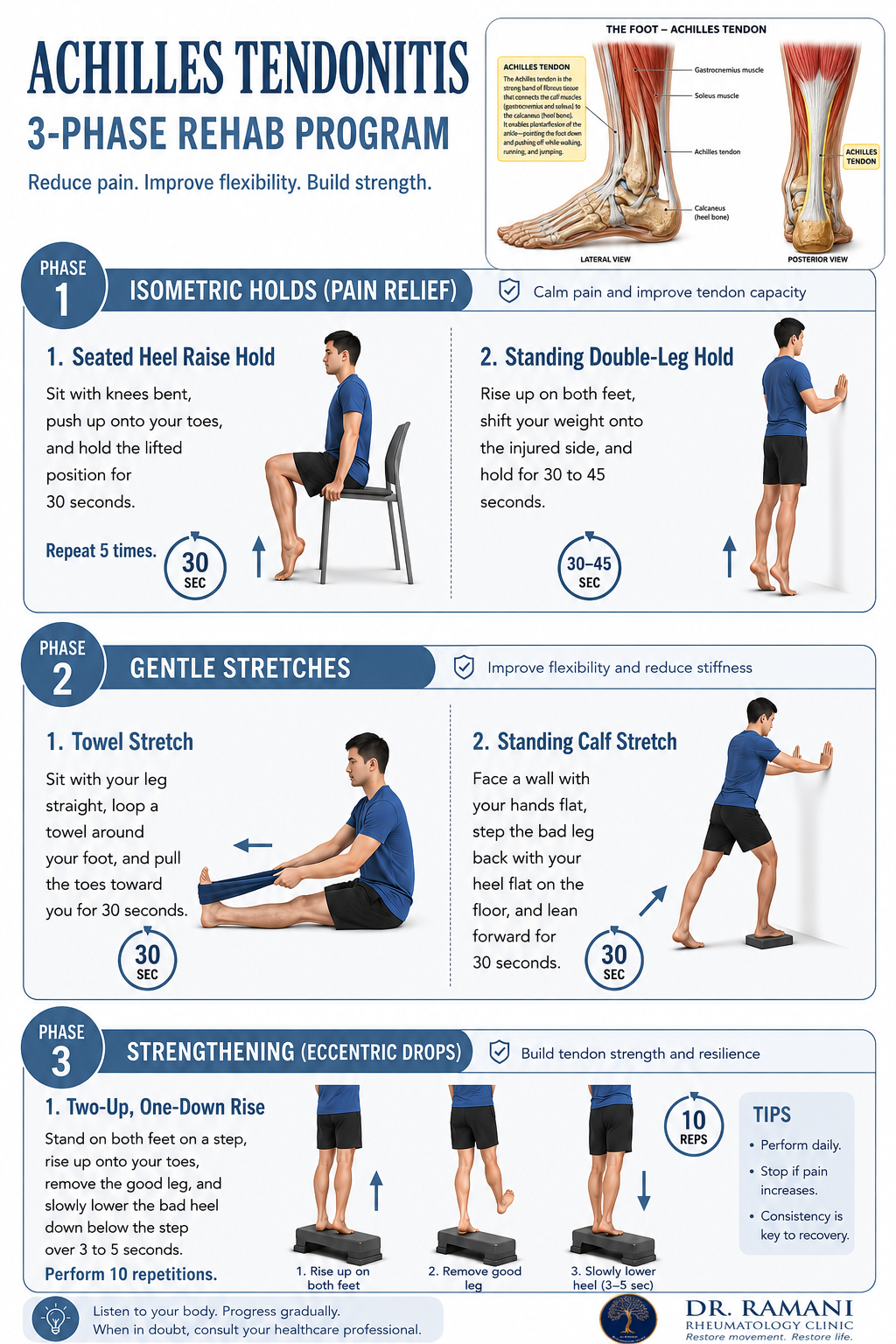
Phase 1: Isometric holds
These controlled holds can help introduce load to the tendon and may temporarily reduce pain for some patients.
- Keep the movement controlled.
- Use a wall or stable chair for balance.
- Begin with both legs if loading one side is too uncomfortable.
- Do not hold your breath.
- Stop if you experience sharp pain, sudden weakness or a feeling that the tendon may give way.
Phase 2: Gentle flexibility
Gentle calf mobility work may help reduce stiffness around the ankle and calf.
- The stretch should feel gentle, not forceful.
- Do not bounce.
- Do not push through sharp pain.
- Patients with pain directly at the heel attachment may need to limit deep ankle bending or modify the stretch.
Phase 3: Progressive strengthening
Slow heel-lowering and heel-raising exercises help rebuild calf and tendon strength so the Achilles can tolerate everyday and sporting activities more effectively.
- Rise using both feet if needed.
- Transfer weight gradually.
- Lower the affected heel slowly and with control.
- Use support for balance.
- Begin on flat ground if exercising from a step is too painful.
- For insertional Achilles pain, do not lower the heel below the level of the step unless specifically advised by a clinician.
- Repetitions, resistance and frequency should be adjusted to the individual rather than progressed automatically.
How much discomfort is acceptable?
Green: Continue
- No pain or only mild discomfort
- Movement remains controlled
- Symptoms settle soon after exercise
- No meaningful increase in stiffness the following morning
Amber: Reduce or modify
- Pain is becoming progressively stronger
- You are changing the way you walk or perform the exercise
- Pain remains noticeably worse later that day
- Morning stiffness is clearly worse the next day
Reduce the number of repetitions, range of movement, resistance or frequency. Consider professional advice if this keeps happening.
Red: Stop and seek assessment
- Sharp or sudden pain
- A popping or snapping sensation
- New bruising or marked swelling
- Sudden loss of strength
- Inability to push off, stand on your toes or bear weight normally
Pain is only one part of monitoring. Swelling, loss of function and next-day symptoms also matter.
Could inflammation be contributing to your heel pain?
Pain where the Achilles tendon attaches to the heel can sometimes represent enthesitis, which is inflammation where a tendon or ligament attaches to bone. Enthesitis may occur as part of conditions such as psoriatic arthritis or other forms of spondyloarthritis.
Consider a rheumatology assessment if Achilles pain is accompanied by:
- Pain affecting both heels
- Prolonged morning stiffness
- Swollen fingers, toes or other joints
- Persistent lower-back or buttock pain that improves with movement
- Psoriasis or a family history of psoriasis
- Recurrent painful or red eyes
- Inflammatory bowel disease or persistent unexplained bowel symptoms
- Repeated tendon problems without a clear mechanical cause
Do not begin this programme if you may have ruptured the tendon.
Seek urgent medical assessment if:
The pain began suddenly with a pop or snap
It felt as though someone kicked or struck the back of your leg
You developed sudden swelling or bruising
You cannot walk or bear weight normally
You cannot push off the affected foot
You suddenly cannot rise onto your toes
The area is very red, hot or swollen and you feel feverish or unwell
You have marked calf swelling, chest pain or shortness of breath
These symptoms require medical assessment and should not be treated as routine Achilles tendinopathy.
When should I arrange a non-urgent assessment?
Consider an assessment if:
- Your symptoms are not improving after several weeks
- Pain is limiting normal walking or work
- You are unsure whether the tendon is partially torn
- The tendon remains swollen or thickened
- Symptoms repeatedly return when you resume activity
- You have diabetes, inflammatory arthritis or another condition that may affect tendon health
- You recently used a fluoroquinolone antibiotic such as ciprofloxacin or levofloxacin
- You take oral corticosteroids or have received an injection around the tendon
- You want to return safely to running or sport
- You are unsure how to progress the exercises
Diagnosis is often based on the history and physical examination. Ultrasound or MRI may be considered when the diagnosis is uncertain, a tear is suspected or symptoms are not responding as expected. Imaging is not automatically required for every patient.
Questions my patients often ask me
Persistent heel pain deserves a proper explanation.
If your Achilles pain is recurring, limiting your movement or accompanied by other joint and inflammatory symptoms, an assessment can help determine the cause and identify a suitable treatment and rehabilitation plan.
Dr. Ramani Arumugam
Consultant Rheumatologist & Internal Medicine Physician
Dr. Ramani Rheumatology Clinic
Website: drramani.co · Instagram: @drramani.rheumatology
Email: enquiries@drramani.co · Telephone: +60 11-4579 8121
This guide is for general education and does not provide an individual diagnosis or treatment plan. Exercise may not be suitable for an acute tendon tear, significant injury or certain medical conditions. Please consult a qualified healthcare professional if you are uncertain about your symptoms or how to exercise safely.
Educational information only · Not a diagnosis