
Sacroiliac (SI) Joint Dysfunction
The sacroiliac joints connect your spine to your pelvis. When they become irritated, inflamed or move poorly, they can cause pain in the lower back and buttock, and make standing, stairs or turning in bed uncomfortable.
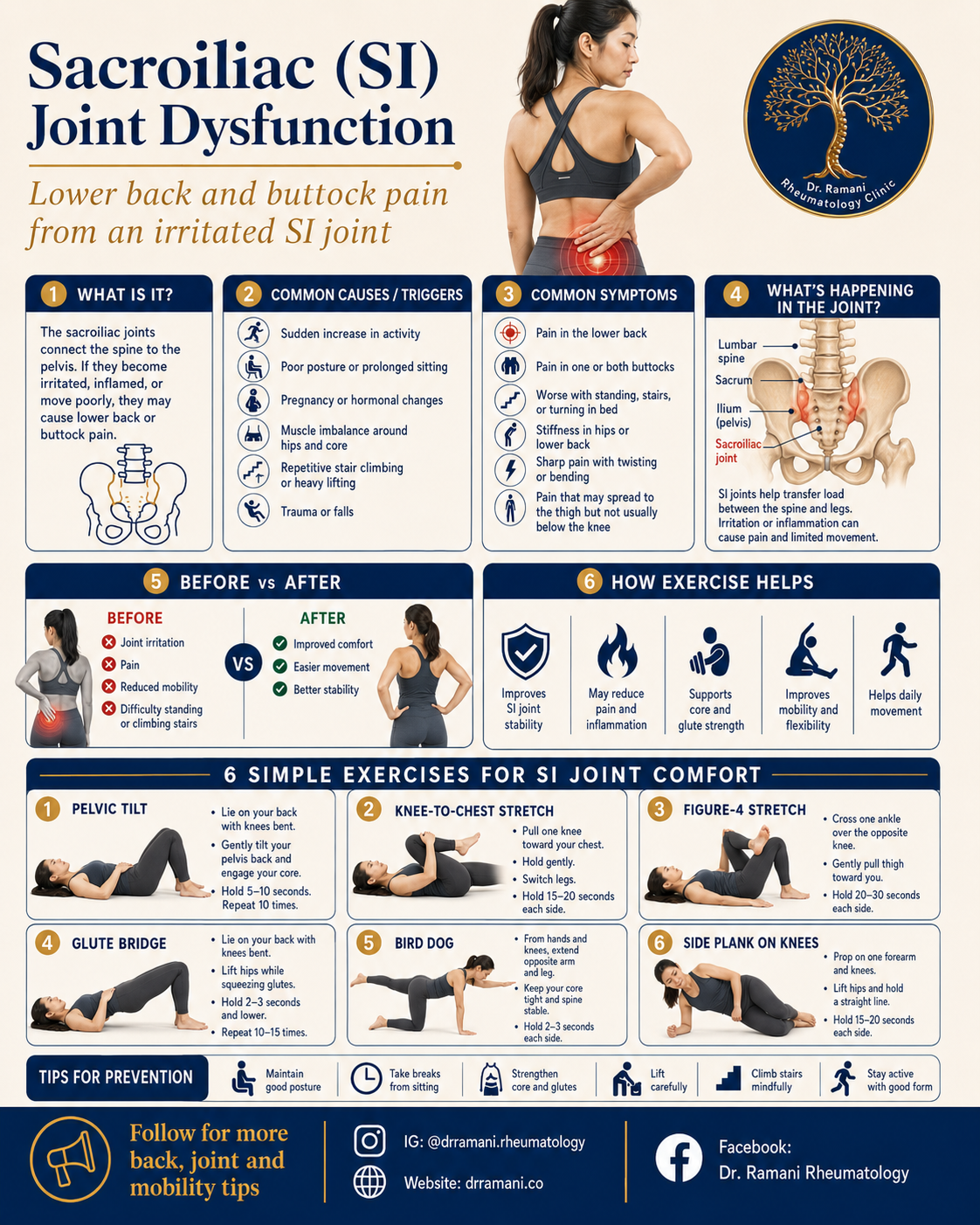
Patient guide from my clinic
What sacroiliac (si) joint dysfunction is
The sacroiliac joints are two small joints where the base of the spine, the sacrum, meets the pelvic bones on either side. They do not move very much, but they transfer load between the upper body and the legs. When one or both joints become irritated or inflamed, the surrounding ligaments and nerves can produce pain in the lower back, buttock, groin or upper thigh. This is usually called SI joint dysfunction. It can be triggered by a sudden increase in activity, poor posture and prolonged sitting, pregnancy or hormonal changes, muscle imbalance around the hips and core, repetitive stair climbing or heavy lifting, and trauma or falls. In some patients, inflammation of the SI joint is part of an underlying inflammatory arthritis such as ankylosing spondylitis or another form of axial spondyloarthritis, which is why the pattern of pain matters.
Symptoms to look out for
Pain in the lower back, often on one side
Pain in one or both buttocks
Discomfort that is worse with standing, stairs or turning in bed
Stiffness in the hips or lower back, especially after sitting
Sharp pain with twisting or bending
Pain that may spread to the thigh but usually not below the knee
Why this matters to a rheumatologist
Most SI joint pain in adults is mechanical, but a smaller and important group of patients have inflammatory sacroiliitis. Clues that make me think of inflammation include pain that starts before age 45, is worse with rest and better with movement, wakes you in the second half of the night, is associated with morning stiffness lasting more than 30 minutes, or is accompanied by psoriasis, uveitis, gut inflammation or a family history of spondyloarthritis. Getting this distinction right matters, because inflammatory sacroiliitis responds to very different treatment from a mechanical strain, and early diagnosis protects the spine over the long term.
Signs I would like you to seek care for
For emergency symptoms please seek urgent or emergency care first rather than waiting for a WhatsApp reply.
New weakness, numbness or loss of sensation in the legs
Loss of bladder or bowel control, or numbness around the groin
Fever, unexplained weight loss or night sweats with back pain
Severe pain after a significant fall or accident
Back or buttock pain that keeps waking you in the second half of the night
Pain that is not improving despite rest, simple pain relief and gentle activity
What a specialist review looks like
In clinic I take a careful history to understand the pattern of your pain, then examine the lower back, hips and SI joints with specific tests. I look for clues of inflammatory arthritis, check other joints, and consider hip and lumbar spine problems that can mimic SI joint pain. Depending on what I find, I may arrange blood tests, X-rays or MRI, which is the best scan for detecting inflammation of the SI joints. Treatment is tailored to the cause. For mechanical SI joint pain this usually means education, activity adjustment, targeted physiotherapy, core and glute strengthening, and suitable pain relief. A guided steroid injection into the SI joint can help selected patients. When the problem is inflammatory sacroiliitis, treatment focuses on controlling the underlying disease, which may include anti-inflammatory medications and, in appropriate cases, disease-modifying or biologic therapy.
Questions my patients often ask me
No. Sciatica is caused by irritation of the sciatic nerve, usually from a lumbar disc or nerve root problem, and pain often travels below the knee. SI joint pain tends to stay in the lower back, buttock and upper thigh. Both can coexist, so a proper examination helps.
Speak with me
Lower back and buttock pain can come from the SI joint, the hip, the lumbar spine or an inflammatory arthritis. An assessment helps identify the real cause so we can plan the right treatment together.
Other conditions I treat
This page is for general education only and does not replace medical advice. Please consult a qualified healthcare professional for diagnosis and treatment.