
Clinical Approach to Inflammatory Arthritis
A practical diagnostic algorithm for doctors assessing joint pain, swelling and morning stiffness in daily clinical practice.
Use this guide to structure early pattern recognition, identify urgent red flags, and decide when rheumatology referral may be appropriate.
Three diagnostic anchors
- Morning stiffness duration
- Number of joints involved
- Pattern: axial vs peripheral, symmetrical vs asymmetrical
Step 0: Is the pattern inflammatory?
Consider inflammatory arthritis when patients present with the following features. Early recognition supports timely referral and improves outcomes.
- Joint pain
- Objective swelling
- Morning stiffness
- Symptoms that recur, persist or involve multiple joints
- Extra-articular clues: uveitis, psoriasis, IBD symptoms or recent infection
- Morning stiffness usually less than 30 minutes
- Pain often worse with activity
- Consider osteoarthritis or non-inflammatory causes
- Morning stiffness more than 30 minutes
- Swelling, warmth or prolonged stiffness
- Symptoms may improve with movement
- Consider inflammatory arthritis
The diagnostic flow
A simple branch point built around morning stiffness duration, joint count and pattern.
Consider degenerative arthritis (osteoarthritis).
Still assess for swelling, red flags and atypical features.
Consider inflammatory arthritis.
Proceed to Step 1.
Count the number of joints involved
Monoarthritis
- Septic arthritis
- Gout
- CPPD (pseudogout)
Oligoarthritis
- Reactive arthritis
- Psoriatic arthritis
- Early spondyloarthritis
Ask about recent diarrhoea, genitourinary infection, psoriasis, nail changes, inflammatory back pain, uveitis and IBD symptoms.
Polyarthritis
Define the pattern
Pathway A · Axial predominant
Axial spondyloarthritis / ankylosing spondylitis
- Inflammatory back pain
- Sacroiliitis
- HLA-B27 positive (HLA-B27 negative disease is possible)
- Recurrent anterior uveitis
- Younger age at onset
- Ask about psoriasis and inflammatory bowel disease
Pathway B · Peripheral arthritis
Rheumatoid arthritis
- Small joint predominance
- MCP and PIP involvement
- Prolonged morning stiffness
- Symmetrical joint involvement
- Extra-articular manifestations may occur
Psoriatic arthritis
- DIP joint involvement
- Nail pitting
- Onycholysis
- Personal or family history of psoriasis
- Consider dactylitis and enthesitis if appropriate
Reactive arthritis
- Lower limb predominance
- Weight-bearing joints
- Recent UTI or diarrhoea
- Common triggers: Chlamydia, Salmonella, Shigella, Campylobacter
Enteropathic arthritis
- Associated with inflammatory bowel disease
- Crohn's disease or ulcerative colitis
- Peripheral arthritis
- GI symptoms
Five anchors to keep in mind
Monoarthritis = septic arthritis until proven otherwise
Nail changes → think psoriatic arthritis
Back pain + uveitis + sacroiliitis → think axial spondyloarthritis / ankylosing spondylitis
Recent diarrhoea or UTI + asymmetric arthritis → think reactive arthritis
Synovial fluid analysis is mandatory in acute monoarthritis where infection or crystal arthritis is possible
A practical checklist
- Duration of symptoms
- Morning stiffness duration
- Number and distribution of joints
- Pattern: symmetrical vs asymmetrical
- Acute vs chronic onset
- Previous similar episodes
- Fever or systemic symptoms
- Recent infection
- Psoriasis or nail disease
- Eye pain, redness or uveitis
- GI symptoms or known IBD
- Back pain pattern
- Medication history
- Family history
- Confirm true synovitis
- Look for warmth, effusion and restricted movement
- Examine small joints of hands and feet
- Check nails and skin
- Screen for enthesitis or dactylitis
- Assess spine and sacroiliac features if axial symptoms
- Look for extra-articular clues
- FBC
- ESR / CRP
- Renal and liver profile
- RF and anti-CCP if inflammatory arthritis is suspected
- Serum urate if gout is in the differential (do not rely on urate alone to diagnose an acute flare)
- Synovial fluid microscopy, Gram stain, culture and crystal analysis for acute monoarthritis
- HLA-B27 if spondyloarthritis is suspected
- X-ray, ultrasound or MRI where clinically appropriate
- Infection, GI or GU testing where reactive arthritis is suspected
When to refer to me
Consider rheumatology referral when:
- Persistent synovitis of unclear cause
- Small joint inflammatory polyarthritis
- Symptoms lasting more than 6 weeks
- Suspected rheumatoid arthritis
- Suspected psoriatic arthritis
- Suspected axial spondyloarthritis
- Recurrent inflammatory monoarthritis
- Oligoarthritis with psoriasis, IBD, uveitis or recent infection
- Positive inflammatory markers with compatible clinical features
- Diagnostic uncertainty
- Symptoms not responding as expected
- Need for DMARD or biologic assessment
- Acute hot swollen joint where septic arthritis is possible
- Fever, severe pain, systemic illness or immunosuppression
- Rapidly worsening monoarthritis
- Acute red painful eye suspicious for anterior uveitis
Download the GP Quick Guide
- One-page triage map
- Referral triggers
- 60-second GP checklist
- Clinic contact details
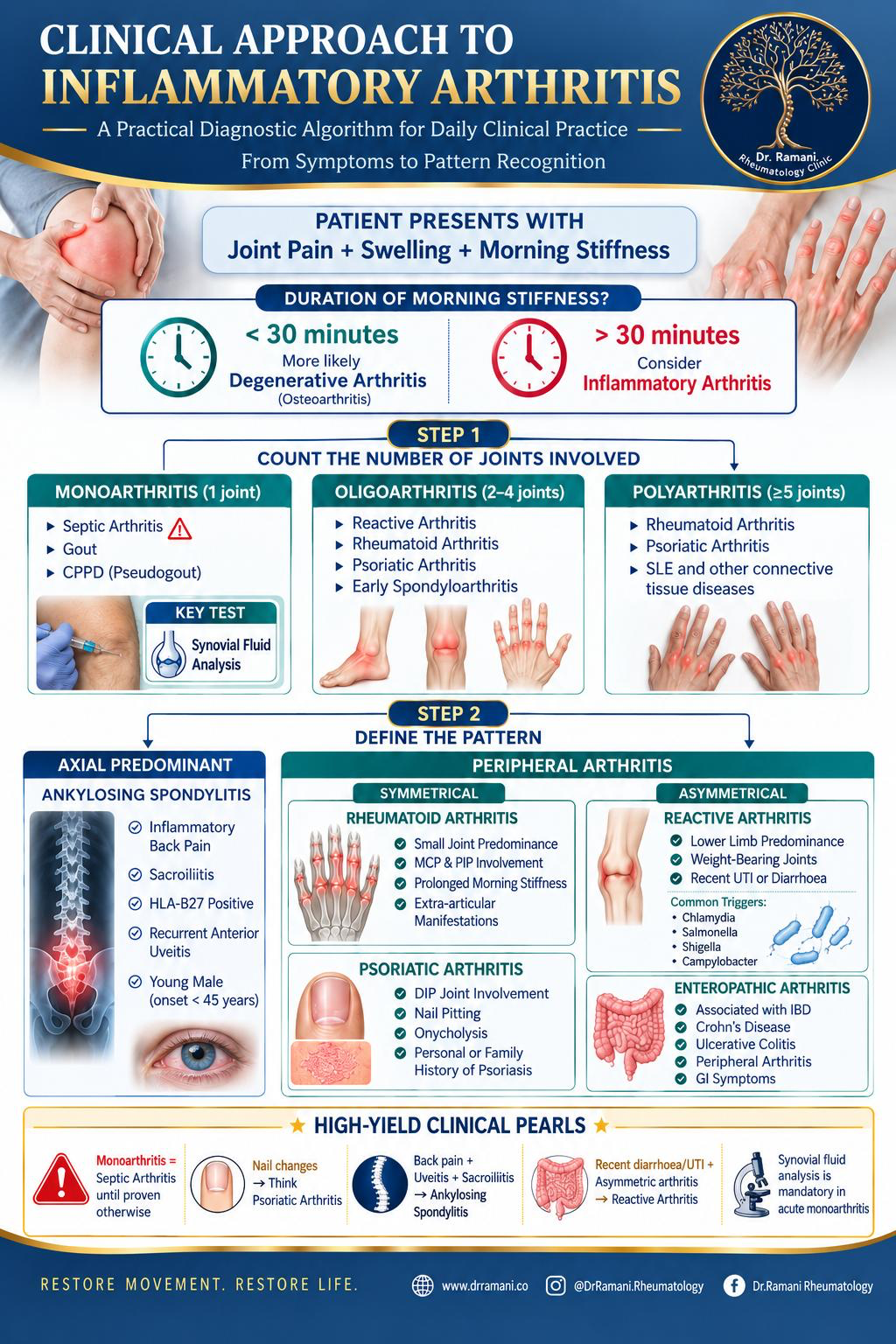
The complete one-page algorithm, from symptoms to pattern recognition.
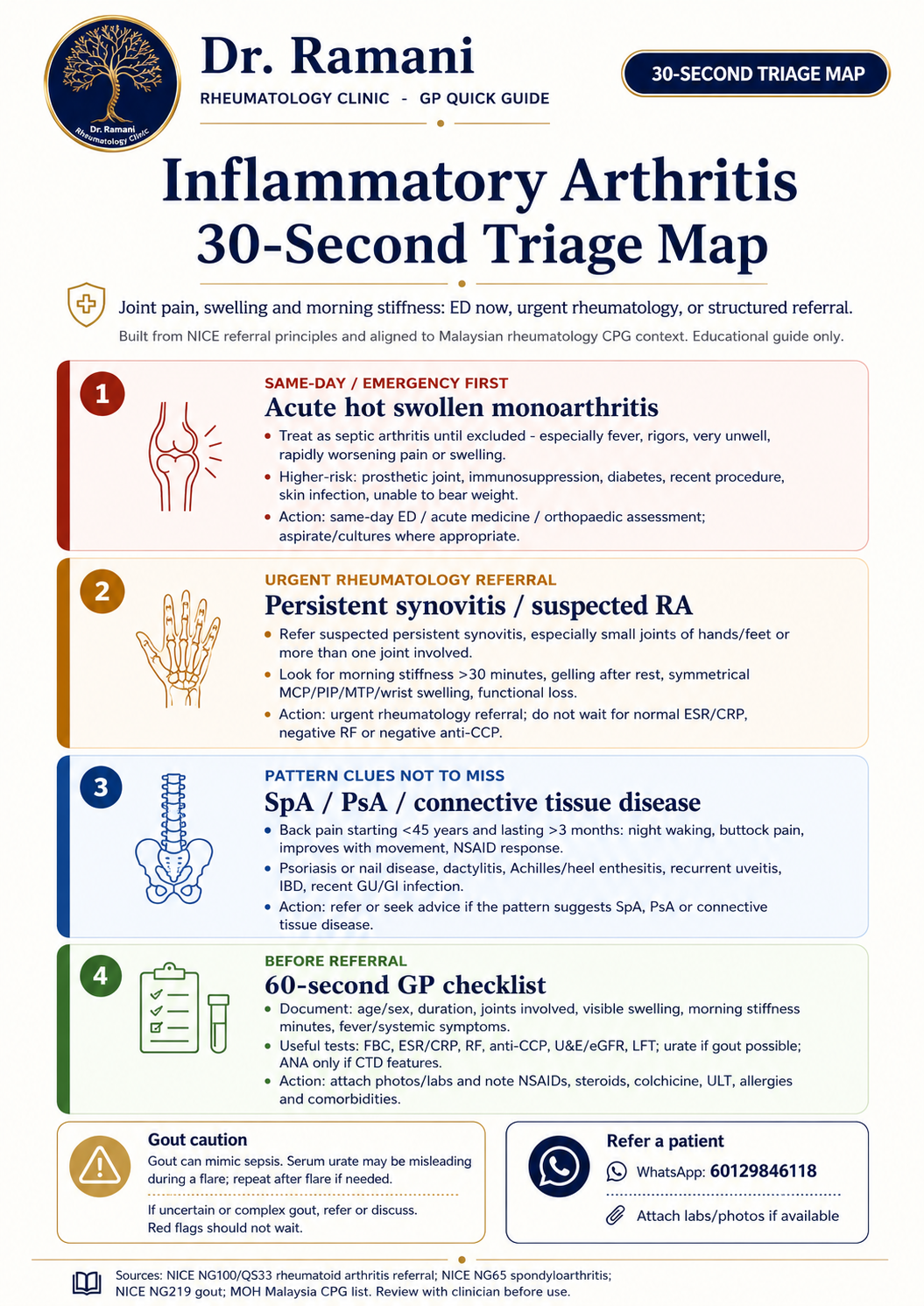
Tap the preview to open full size, or use the download button above to save a copy.
Need a rheumatology opinion?
If your patient has persistent synovitis, suspected inflammatory arthritis, recurrent monoarthritis or diagnostic uncertainty, my clinic can support further assessment.
Doctor-facing FAQ
Educational · Not a diagnosis. This page is a clinical education guide for doctors and is not a substitute for clinical judgement or a complete diagnostic or treatment guideline. All content is medically reviewed and approved by Dr Ramani Arumugam, Consultant Rheumatologist and Internal Medicine Physician at Dr Ramani Rheumatology Clinic.