
Psoriatic Arthritis
Psoriatic arthritis often hides in plain sight. Patients tell me about a painful finger, a stiff back or a swollen ankle, and only later mention psoriasis on the scalp or a childhood family history. It matters to me that we recognise psoriatic arthritis early, because the right treatment protects your joints, your tendons and your quality of life.
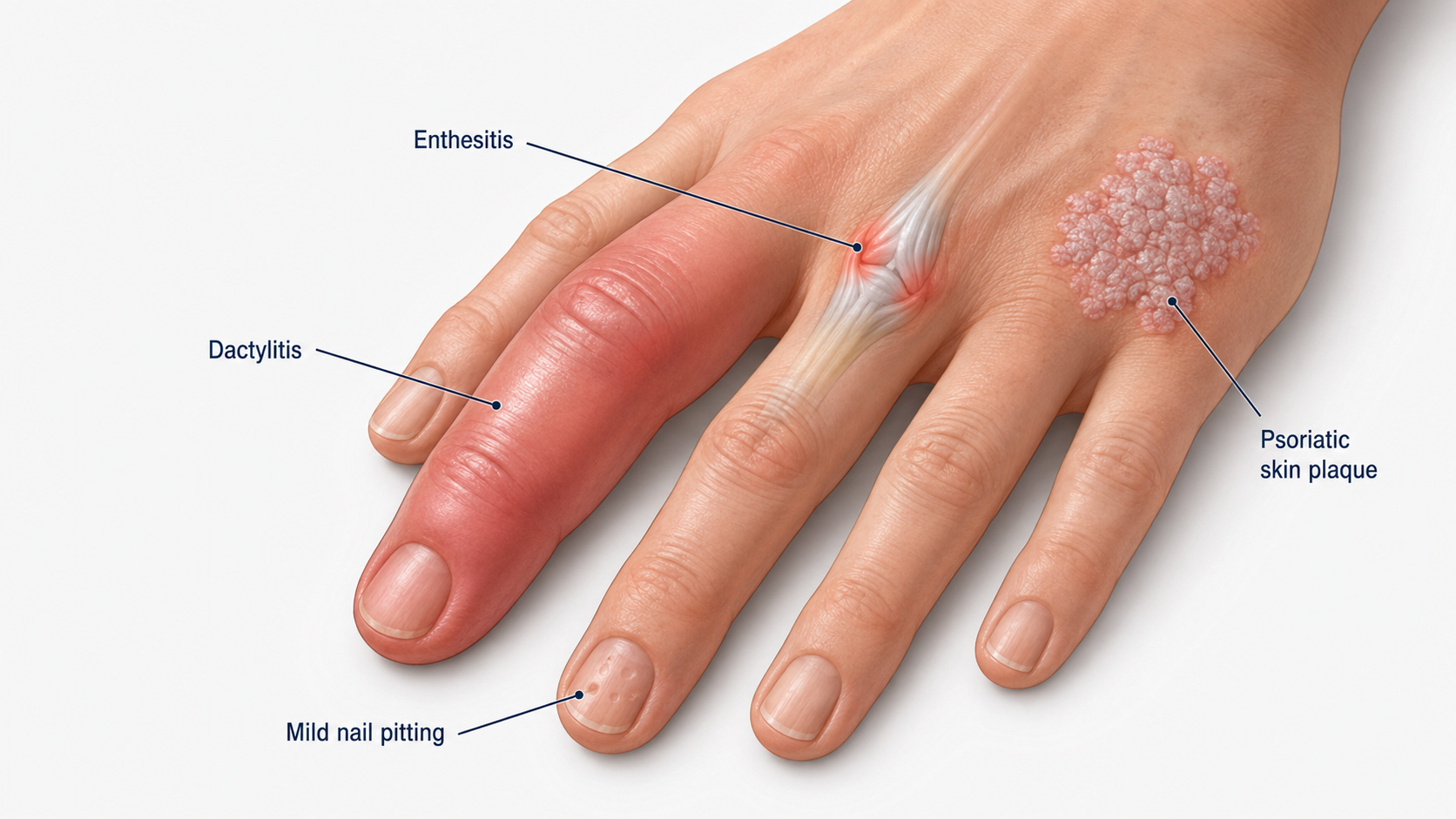
Typical features of psoriatic arthritis: dactylitis, enthesitis, nail pitting and psoriasis.
Psoriatic arthritis medications and treatment
Psoriatic arthritis can affect joints, skin, tendon insertions, whole fingers or toes, and the spine. This is how I explain the treatment options in clinic, and how we decide together which one fits you.
Which part of the disease is loudest, and what we then discuss
This is a map of the conversation, not a prescription. Your own treatment depends on your examination, tests, other health conditions and your preferences.
Treatment targets more than one thing at a time.
When I treat psoriatic arthritis, I am not only looking at swollen joints. I look across the whole condition: the peripheral joints, the skin and nails, the tendon insertions (enthesitis), any sausage-like swelling of a finger or toe (dactylitis), and the spine and sacroiliac joints.
We agree a target together, usually remission or low disease activity, then review you at intervals and adjust if we are not getting there. That is what treat-to-target means in practice. Your function, your fatigue, your work and your own priorities are part of the assessment, not an afterthought.
Every step is a shared decision. I explain the options, what each one asks of you in terms of monitoring and precautions, and we choose together.
Anti-inflammatory medicines help symptoms, but they do not change the disease.
Non-steroidal anti-inflammatory medicines (NSAIDs) can settle pain and stiffness, and they have a genuine place, particularly early on or while we are waiting for a disease-modifying medicine to take effect. Local steroid injections are sometimes used for a single stubborn joint or tendon area.
I treat these as short-term and supportive. They do not stop joint or tendon damage, so they do not replace disease-modifying treatment when that is needed. NSAIDs also need care if you have kidney disease, stomach ulcers, high blood pressure or heart disease, so please do not simply buy them long term without a review.
Tablets that dampen the disease itself.
Conventional disease-modifying anti-rheumatic drugs include methotrexate, leflunomide, sulfasalazine and ciclosporin. They are usually taken by mouth, they act on the immune process rather than only on pain, and they take some weeks to show their benefit.
Methotrexate is commonly preferred when peripheral arthritis and significant skin psoriasis coexist, because it can help both. It is less helpful for spinal disease and less reliable for enthesitis, so the dominant pattern really matters when we choose.
These medicines need regular blood tests, and alcohol, pregnancy plans and other medicines all come into the discussion before we start.
Injected or infused medicines that block a specific pathway.
Biologics target one part of the immune pathway rather than dampening things broadly. In psoriatic arthritis the groups I discuss are:
- TNF pathway medicines, such as adalimumab, etanercept and infliximab.
- IL-17 pathway medicines, such as secukinumab and ixekizumab.
- IL-12/23 and IL-23 pathway medicines, which are particularly relevant when psoriasis of the skin is a major part of the picture.
A biologic is not a last resort. For some patients, especially when spinal disease, enthesitis or dactylitis dominates, it is the more suitable disease-modifying choice from the start. Before starting, we screen for infections including tuberculosis and hepatitis, and plan vaccines.
Tablets that act on specific signalling pathways.
JAK inhibitors, such as tofacitinib, upadacitinib and baricitinib, block intracellular signalling and are taken as tablets. They can help joints, enthesitis and spinal symptoms, and they suit some patients who prefer not to inject.
PDE4 inhibition is another oral approach, generally considered for milder disease and where a gentler immune effect is preferred. It is usually less potent for active, damaging joint disease.
With JAK inhibitors in particular, I go carefully through your age, smoking history, cardiovascular risk, clot risk and cancer history, because those factors influence whether this class is a good fit for you.
Two people with the same diagnosis can need very different treatment.
The things I weigh up with you include:
- Which domain dominates: peripheral joints, spine, enthesitis, dactylitis or skin and nails.
- How active and how widespread your psoriasis is.
- A history of uveitis, which makes some classes more suitable than others.
- Inflammatory bowel disease, which similarly narrows the choice.
- Infection risk, including recurrent infections, tuberculosis exposure and hepatitis.
- Cardiovascular risk, clot risk and any history of cancer.
- Pregnancy plans, breastfeeding, and fertility considerations.
- Other medicines and other conditions, such as kidney or liver disease.
- Your own preference between tablets, self-injections and hospital infusions, and what is practical for your life and budget.
Approvals and availability differ by medicine, by disease feature and by country. Not every medicine is approved for every feature of psoriatic arthritis, and what is available in Malaysia may differ from what you read online. I will tell you where your options stand.
The plan around the medicine matters as much as the medicine.
- Before starting: baseline bloods, and screening for tuberculosis and hepatitis for most biologics and targeted oral medicines.
- Vaccines: best planned before we start where possible. Live vaccines generally need to be avoided once you are on these medicines, so please check with me first, including before travel vaccines.
- Ongoing bloods: at intervals to check blood counts, liver and kidney function, with a schedule I will set out for your particular medicine.
- Infection precautions: tell me about fever, a persistent cough, shingles, or any infection needing antibiotics. Some medicines are paused during a significant infection or around surgery.
- Skin checks and sun care: worth keeping up, and I am happy to work alongside your dermatologist.
Please do not start, stop, swap or change the dose of any of these medicines without your treating clinician. Sudden changes can lead to a flare, and some medicines need specific timing around infections, surgery and pregnancy.
Medication guides on my site
Educational content only, and deliberately without doses. Availability and approvals differ between medicines, disease features and countries. Please do not start, stop or change any medicine without your treating clinician.
What psoriatic arthritis is
Psoriatic arthritis is an inflammatory arthritis that can affect people with psoriasis, sometimes before the skin ever flares. It can involve individual joints such as fingers or knees, the small joints closest to the nails, the tendons and their attachments (enthesitis), the whole finger or toe as a sausage-like swelling (dactylitis), the nails, and the spine.
Symptoms to look out for
Painful, swollen finger, toe, knee or ankle joints
A whole finger or toe that swells up like a sausage
Pain and stiffness at the back of the heel or under the foot
Lower back or buttock pain that is worse with rest and better with movement
Morning stiffness lasting more than 30 minutes
Nail changes such as pitting, ridging or lifting from the nail bed
A personal or family history of psoriasis, even mild
Why this matters to a rheumatologist
As a rheumatologist, I look at psoriatic arthritis as more than a joint condition. I assess the joints, tendons, spine, skin and nails, because psoriatic arthritis can move between these areas. Early diagnosis matters because joint damage can happen quietly. Modern treatment is very effective, and I want to reach it before damage sets in.
Signs I would like you to seek care for
For emergency symptoms please seek urgent or emergency care first rather than waiting for a WhatsApp reply.
A swollen, hot, red joint, which may need urgent review
New joint swelling that is not settling after a week or two
A whole finger or toe that swells like a sausage
Persistent heel or foot pain, especially in both feet
Back pain that wakes you at night or stiffens you in the morning
Eye redness, pain or blurred vision (possible uveitis) which needs urgent eye review
What a specialist review looks like
In clinic I take a careful history, examine your joints, tendons, nails and skin, and order blood tests and imaging where helpful. If I confirm psoriatic arthritis, I explain the diagnosis in plain language and discuss treatment options ranging from NSAIDs and steroid injections through to disease modifying medications such as methotrexate, and modern biologic and targeted therapies. Treatment is chosen based on which parts of you are involved.
Questions my patients ask me
About the condition
Yes. In some patients the joint symptoms appear first, sometimes years before the skin. A strong family history of psoriasis, nail changes or a typical joint pattern can help me make the diagnosis.
Medications and treatment
Speak with me
If you have psoriasis with joint, tendon, back or nail symptoms, or unexplained finger or toe swelling, please seek specialist care. I would like to help you catch psoriatic arthritis early and treat it well.
Other conditions I treat
This page is for general education only and does not replace medical advice. Please consult a qualified healthcare professional for diagnosis and treatment.